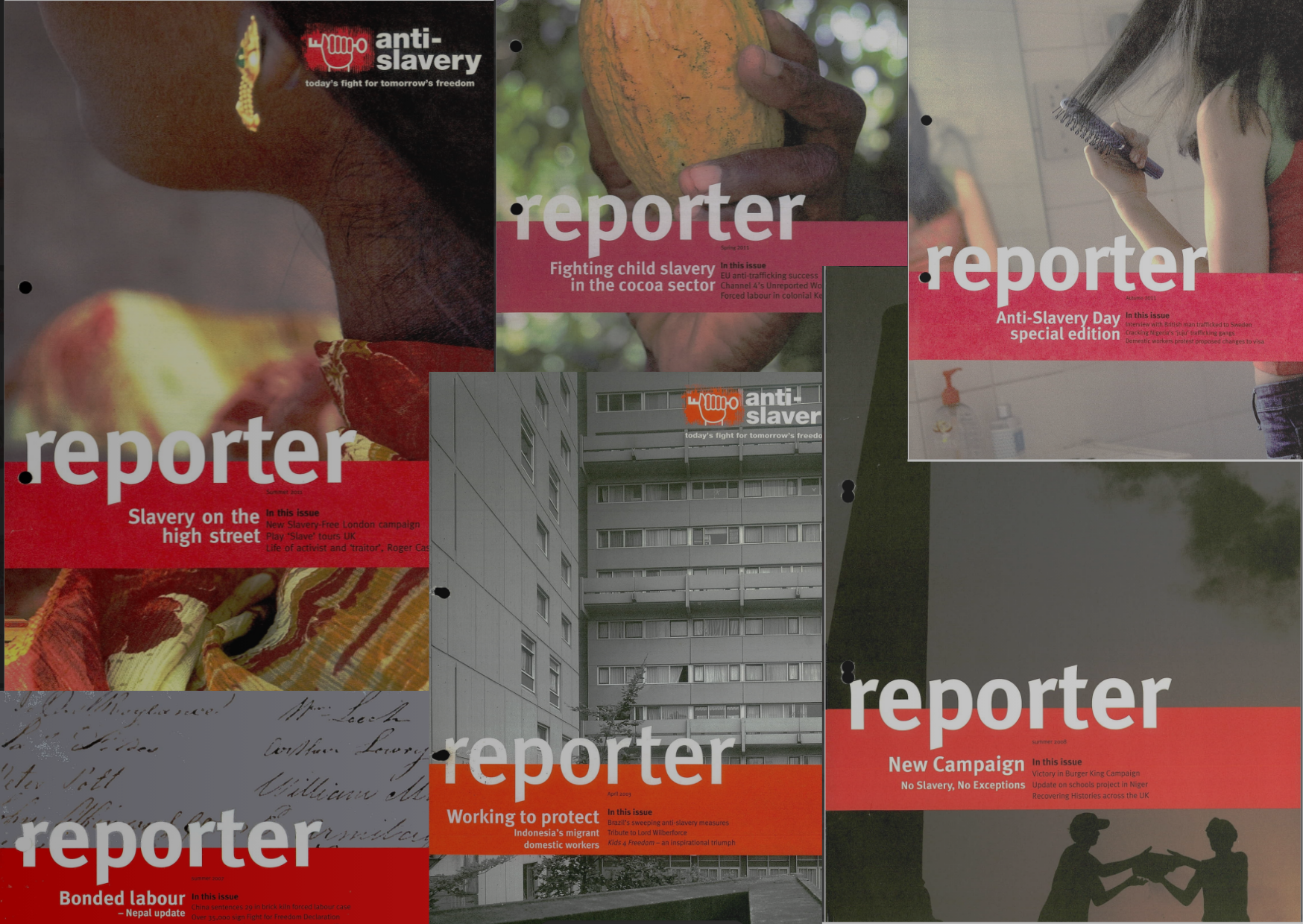
This June marked 200 years since the very first issue of The Anti-Slavery Reporter was published. Today, as we commemorate the anniversary of the 1926 Slavery Convention, historian Ryan Hanley revisits the inaugural issue of the Reporter to consider how anti-slavery campaigning has changed over the years, and what we can learn from the achievements – and mistakes – of the past.
The inaugural issue of the Reporter, published as The Anti-Slavery Monthly Reporter on 30 June 1825, is a fascinating historical artefact, but also an undoubtedly challenging read. For one thing, it opens with a reminder that this periodical – one of the longest-running charity publications in the English language – is a fair bit older than the organisation whose activities it reports. The Reporter was first devised and published by the London Committee of the ‘Society for the Mitigation and Gradual Abolition of Slavery throughout the British Dominions’, some fourteen years before the Anti-Slavery Society – which went on to become Anti-Slavery International – was founded.
We tend to think about the slavery debates in nineteenth-century Britain in binary terms: the anti-slavery camp wanted to free all enslaved people immediately, while the pro-slavery camp wanted to maintain or expand it. But in the 1820s, the terms of the debate were a bit more complex.
While there were many committed radicals such as Elizabeth Heyrick and Robert Wedderburn advocating for immediate abolition, the more ‘respectable’ philanthropic organisations took a different approach. As their rather lengthy name suggests, the ‘Society for the Mitigation and Gradual Abolition of Slavery’ was originally formed in January 1823 with the aim of working with the British government – and sometimes, with slaveholders in the colonies – to diminish the worst of the harms involved in slavery, and only very gradually replacing it with other forms of free or quasi-free labour. Needless to say, this is a rather different strategy from the one Anti-Slavery-International pursues today, and it was not an altogether popular idea at the time.
The first number of the Reporter gestured towards this in the ‘address’ printed at the beginning of each issue. One aim of their new periodical, the Committee claimed, was to counter ‘the misconceptions which have occasionally been formed respecting the design and objects of the Society, but more frequently respecting the means which are deemed by the Committee most desirable to be employed.’ The best way to do this, they reasoned, was by sharing as much information about their work as possible, and selling it cheaply through the many regional anti-slavery associations that had sprung up around the country.
It makes sense, then, that the first issue consisted entirely of an account of the speeches given at the annual meeting of the Society – only their second public assembly since they were founded.
Reading it back today, the record of this important meeting certainly shows its age at some points. Enslaved or formerly enslaved people themselves were not invited to share their stories. The absence of women among the speakers is also telling, especially when we consider that it was women who led the massive boycotts of ‘slave-grown’ sugar throughout Britain during the 1790s, and that they would go on to assume an even more central role in the popular campaigns of the 1820s and 1830s. With Prince William Frederick, Duke of Gloucester and nephew of King George III presiding as Chairman at the meeting, it was all rather an exclusive affair.
Yet if we scratch beneath the slightly stodgy late Georgian surface of this inaugural issue, we can also see hints of the more participatory approach that eventually went on to secure the Society’s objectives, including the passing of the Abolition of Slavery Act in 1833. All the speakers, for example, stressed how important the support of ‘the people’ would be for the cause, with one declaring ‘that if the people of England did but will it to be so, slavery would cease.’
The issue of resistance and revolution by enslaved people also hung over the meeting, though not everyone was keen to acknowledge it. The Irish statesman Daniel O’Connell openly praised the Venezuelan revolutionary leader Simón Bolívar for liberating enslaved people in South America. O’Connell even opined that when enslaved Africans saw ‘warriors and statement of his own race’, as in, for example, post-revolutionary Haiti, then universal liberation could not be far off.
Still, it is hard to ignore a certain strain of self-congratulation running through many of the speeches. The first speaker, Lord Calthorpe, began by thanking the legendary parliamentary abolitionist William Wilberforce (who had retired the previous year) for his service to the cause. Lord Milton then rose to express his thanks to James Stephen for his contribution. William Smith rose to thank Granville Sharp, Thomas Clarkson, William Pitt, Charles Fox, and George Saville for their work. Thomas Fowell Buxton then rose to thank the previous speaker for rising to thank the others. William Wilberforce the Younger then rose to thank Buxton for thanking Smith for thanking the others. He thanked all the other speakers for passing a motion of thanks dedicated to his father. He then closed his speech by thanking Prince William for chairing the meeting.
Clearly, anti-slavery work looks very different now from how it did when the Reporter published its first issue. Today, Anti-Slaver International works closely with survivors, advocates for corporations and governments to be held accountable, and advocates for change that would prevent modern slavery to continue.
The anti-slavery movement today is far more inclusive and diverse than it was during the days of the all-male, all-white London Committee. But perhaps what is most striking when we read the inaugural edition of the Reporter is how many of the issues facing anti-slavery activists remain relevant today.
As sceptical as we might be of their methods, it is undeniable that these Georgian philanthropists were committed to the idea that slavery was incompatible with human dignity. As a voluntary organisation, the Society of 1825 sought to balance its commitment to working within existing structures in the short term with the desire for more sweeping legal and structural changes in the longer term. It is clear that they also recognised the need for support from both well-connected and influential individuals, and a broad-ranging movement comprised of ‘ordinary’ people. That much, at least, still holds true today.