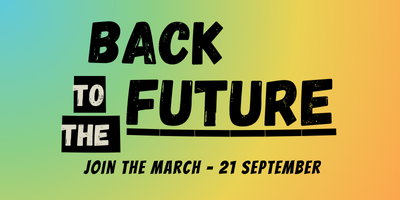
For Democracy and Against Deregulation. Anti-Slavery International’s CEO, Helen Moulinos, joined by the Head of UK and European Advocacy and other civil society organisations, are joining the Back to the Future march, to demand that the EU prioritises human and environmental rights.
Between 21 and 23rd September, I will be walking with Anti-Slavery International, in the Back to the Future march to stand up against the EU’s push for deregulation.
Alongside Friends of the Earth Europe (FOEE), the European Coalition for Corporate Justice (ECCJ) and the European Trade Union Confederation (ETUC) and many others, we will embark on a 95-kilometre journey, from Maastricht to Brussels to send a clear message: we will not accept the European Union stepping back from its responsibility to protect people and the planet.
Across different landscapes, towns, and villages, our goal is to raise awareness on the EU’s Omnibus “simplification” proposal – a sweeping move for deregulation, and a blow to the Corporate Sustainability Due Diligence Directive (CSDDD).
Why is the Omnibus a problem?
CSDDD was designed to ensure corporate transparency and accountability, to protect people and the planet. It was approved after many years of campaigning by Anti-Slavery International and its allies.
But recently, EU institutions have initiated an unprecedented rollback of legislation, including on CSDDD with the Omnibus proposal, under the vague banner of “simplification” and “competitiveness.” Without an impact assessment, evidence, or appropriate consultation and engagement, the proposal sends a dangerous signal that corporate interests take precedence over human rights.
Effective laws to identify, prevent and address modern slavery in supply chains are critical for many communities and workers across the world. Our core demand is that CSDDD safeguards human rights, and in particular that it protects people against modern slavery.
We believe the Omnibus proposal violates European treaties and that the European Commission has broken its own rules that require that such changes are impact assessed, and citizens are engaged in meaningful consultations.
The higher corporate thresholds proposed in the Omnibus will significantly reduce the number of companies covered under the directive by 50 to 75 per cent. As a result, fewer companies will be required to conduct due diligence of their business and their supply chains, and this risks pushing many workers into situations of modern slavery, undetected and outside of legal enforcement.
The initial directive inspired hope and was supposed to ensure that corporations tell us — the public, consumers, citizens, and workers alike — what is happening in their supply chains and critically, to address harm. It was an opportunity to hold companies to account from human rights abuses such as forced labour, child labour, debt bondage, and environmental destruction. And citizens care. In 2021, an overwhelming 80% of Europeans wanted strong laws and effective enforcement to hold corporations accountable. Conducting due diligence and preventing harm in their business is beneficial for companies. It can help give assurances to consumers that their products and services do not rely on human rights and environmental abuses.
Weak regulation allows heinous human rights atrocities and environmental harms to go undetected and unaddressed. Profit must never take precedence over human dignity, nor over the prevention of modern slavery.
Why Maastricht?
Our march begins in Maastricht, the city where the 1993 Maastricht Treaty was signed. An important foundation treaty, it commits to: “safeguarding the common values, fundamental interests and independence of the Union,” and “to develop and consolidate democracy and the rule of law, and respect for human rights and fundamental freedoms”.
In 2025, an EU-wide poll on values revealed that European citizens overwhelmingly care about human rights, fairness, and environmental protection. The Eurobarometer survey also highlights the values Europeans would like the European Parliament to defend the values of peace, democracy, and the protection of human rights at the European and global levels.
So, we must ask: whose values are EU leaders safeguarding with the Omnibus?
Our joint complaint to the EU Ombudsperson
Anti-Slavery International, alongside a coalition of eight NGOs including ClientEarth, Clean Clothes Campaign, European Coalition for Corporate Justice, Friends of the Earth Europe, Global Witness, Notre Affaire À Tous and T&E raised a formal complaint earlier this year in April 2025 to the EU Ombudsperson against the EU for undermining its own commitments to good governance.
The modern slavery supply chain problem and why we must not look away
Modern slavery is closer than you think. From the clothes we wear, the food we eat, and the technology we use every day, it is sadly present in the goods and services we use in our everyday lives. Most products pass through a long chain of producers, manufacturers, distributors and retailers before they get to us, the consumers. Complex cross-border supply chains make it difficult to oversee who is working where and under what conditions.
The ILO estimates that 27.6 million people are living in forced labour, 17 million in the private sector, and that US$236 billion of illegal profits are generated annually where people are made to work for little or no pay.
The EU is the world’s largest single market with 450 million people and 23 million businesses within it. So, EU laws that affect businesses can have a global impact.
History shows the danger of backsliding
The EU has prided itself on being a global leader in human rights and the rule of law. But with the Omnibus, it risks breaking its own promises and opening the door to hypocrisy. Across the abolition, humanitarianism, and the enlightenment movements in Europe, history demonstrates that progress is achieved only when leaders choose courage over convenience.
Economic and political arguments about competitiveness and “administrative burden” date back well over 200 years, when Europeans started to ask serious questions about the morality of enslavement under British, Portuguese, French and Dutch colonial rule.
It is far past time that dehumanising arguments and practices that hold profit in higher regard than human dignity are eradicated.
How you can support
- Meet us in Maastricht to send us off, cheer us along the way or meet us in Brussels to show your support.
- Write to your MEP and demand they reject the Omnibus and restore the CSDDD.
- Sign this public petition run by Justice is Everyone’s Business
- Donate to Anti-Slavery International to strengthen our campaign and continue to fight for freedom and hold corporations and the EU accountable for protecting human rights and modern slavery in supply chains.
- Share this blog on social media and with your networks and count yourself a concerned voice in our movement.