This International Migrants Day, the International and Thematic Advocacy team looks at the Kafala system in Lebanon, a country where the experiences of migrant workers are often overlooked.
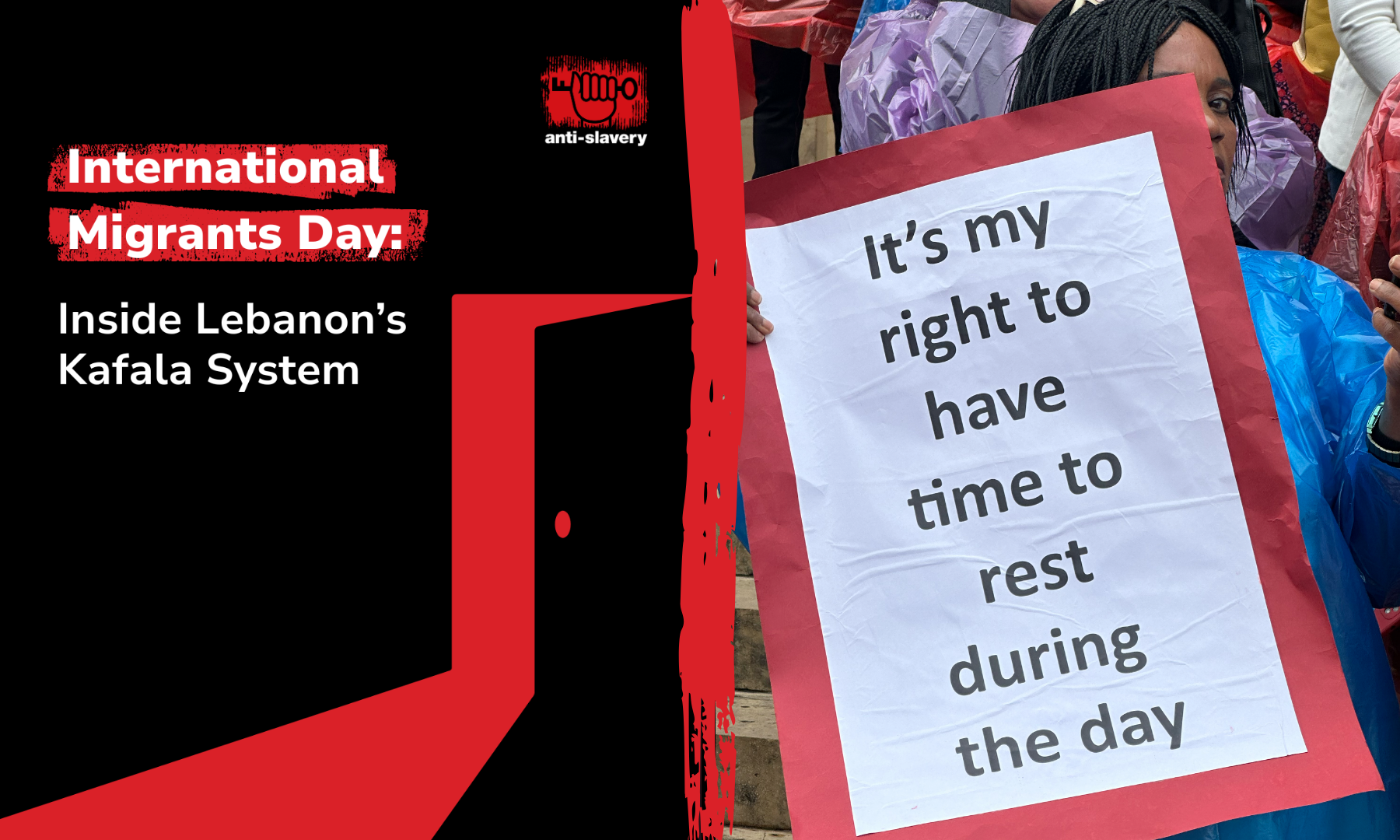
Credit: (L) Anti-Slavery International. (R) Labour Day Protest in 2023. Dara Foi’Elle for Migrant Workers Action.
On 18 December we mark International Migrants Day, celebrating the millions of people who leave their country of origin in search of better opportunities, fleeing conflicts, climate-related disasters or economic pressures, for example. At the same time, we highlight the abuses many migrant workers face, including risks to modern slavery, particularly under exploitative systems like the Kafala system.
What is the Kafala system?
It’s a sponsorship system through which certain countries – notably Gulf Cooperation Countries, and Jordan and Lebanon – manage migrants’ residence and employment visas.
This system requires a local employer to sponsor a migrant worker as an essential pre-requisite for them to be able to obtain a valid visa to live and work in the destination country. This creates a dependency of the worker on their employer, and it increases the worker’s vulnerability to modern slavery as they become dependent on their employer, unable to leave without permission, and often too afraid to report abuse for fear of retribution.
Often, discussion around the experiences of migrant workers under Kafala focus on situations in Gulf Cooperation Council countries, while the experiences of workers in Lebanon (and Jordan), where Kafala also exists, are often overlooked.
In this blog, we take a look at the Kafala system in Lebanon, to help shed a light on the challenges that migrant workers face in the country.
The situation in Lebanon
According to the United Nations, around 250,000 domestic workers are employed in Lebanon. 99% of workers enter the country on worker permits, but many later become undocumented. Most of these migrant workers are women who migrated from Ethiopia, Bangladesh and the Philippines. These women often experience abuse and forms of severe exploitation at the hands of their employers that amount to conditions of modern slavery.
For example, the experiences of many migrant domestic workers in Lebanon often display signs of excessive overtime and abusive working and living conditions:
“I would wake up at 5am in the morning. Clean the dishes, the tables, chairs, dust everything, including all their decorations and sculptures, clean the floor, clean the doors and windows. I had to move the table, which was very heavy, fold the carpets, start hoovering under the carpet and furniture, and clean the rooms. Then everyday their sons would come with their wives, I would have to clean the dishes, prepare the Shisha, everything would finish at 10:30pm. I was only given breakfast at 11 or 12 am, and that was just some Khebbez [Arabic flatbread] and tea without anything.”
Other testimonies documented by Migrant Workers’ Action (MWA) show the bleak reality of deception, debt bondage and restriction of movement:
“Lucy told MWA that she was working in a supermarket when she was approached by someone who told her she would be making 450 USD if working as a receptionist in Lebanon. She adds “I was trying to save money to go to university. So I accepted. I signed a contract in Arabic, I wasn’t sure what I was signing as there was no translation. I arrived in Lebanon in January 2012. I was very surprised to be in someone’s house and not in an office. My employer laughed and told me ‘It’s me who bought your ticket, so you are my property. You must work and repay me my money’. Once I entered the house I never saw outside. Three years I worked there and didn’t get one dollar”. After three years of working in a situation which amounts to forced labour, Lucy ended up escaping one night when her employers forgot to lock the door.“
MWA and other NGOs have documented countless cases of workers being routinely forced to work up to 18 hours a day, having their wages withheld or stolen, and being denied days off by their employers. And in cases where workers have asked for improvements or release from their conditions, employers have used many forms of physical, verbal and emotional abuse to force migrant domestic workers to continue working.
Other reports highlight the risk of trafficking for migrant domestic workers as well: in some cases, this is facilitated by members of their own community, with migrant women working for Lebanese recruitment agencies who encourage escaping from their employer’s households under false promises of better working conditions. Many migrant domestic workers who followed these directions ended up being trafficked into forced commercial sexual exploitation.
The impact of conflict
The recent escalation of the conflict in Lebanon, driven by the ongoing genocide in Gaza, has worsened an already severe humanitarian crisis.
Lebanon has been struggling under a long-term financial crisis, the lasting effects of COVID-19, and the devastation caused by the Beirut Port explosion. Together, these pressures have created an unstable environment, increased poverty, and fuelled social tensions, including rising anti-migrant sentiments.
As the conflict intensified, many migrants were left stranded. When employers fled the country, migrant workers were often abandoned without pay, safe housing, or access to their passports. With no financial support and no safe way to return home, many have found themselves trapped in an active conflict zone. Responses from the Lebanese Government have also deepened existing inequalities, as migrant workers have frequently been excluded from official shelters and emergency protection measures reserved for Lebanese citizens. Without access to aid or secure accommodation, their risk of being re-trafficked grows.
The breakdown of law and order has also created new opportunities for criminal organisations to exploit migrant workers with little fear of consequences. Evacuation routes and overcrowded displacement camps have become particularly dangerous locations, where stranded migrants may be targeted for modern slavery and trafficking, including forced marriage and forced commercial sexual exploitation.
Similar cases occurred during the COVID-19 pandemic and following the Beirut Port explosion, for example, where MWA documented cases of migrant domestic workers being re-trafficked. During the 2024 war in Lebanon, reports also showed that displaced and destitute migrant domestic workers were sexually exploited, including being coerced into sex trafficking rings.
What needs to happen?
In the long-term, the Lebanese Government should replace the Kafala system with one that puts human rights and safeguarding at its core and allows migrant workers to enjoy the same protections and rights as national workers, with full access to justice.
The International Labour Organization (ILO) has made recommendations on making the process of migration for employment safer. For example, raising awareness among potential migrants on the risks and logistics of migration can reduce the risks of being trapped in exploitative situations.
But wider reforms are necessary to achieve meaningful systemic change, including:
- criminalising the practice of passport confiscation
- ensuring that migrant domestic workers are covered under national labour laws
- and granting all migrant workers the right to freedom of association.
Lebanon should also sign onto key international conventions, like the ILO Domestic Workers Convention, the Protocol of the 2014 Forced Labour Convention and the Convention on the Protection of the Rights of All Migrant Workers and Members of Their Families.
Lebanon should also improve its enforcement of investigations, prosecution and penalties to hold abusive employers accountable for exploiting their workers.
These are crucial steps to ensure Lebanon promotes the rights and freedoms of workers in line with international labour law standards.
What can we do?
Regardless of where we come from, we all deserve a chance to make a better life for ourselves and our loved ones. We all have our part to play in ensuring our freedoms are protected.
This International Migrants’ Day here’s how you can act:
- Keep up to date with the work of Anti-Slavery International – we want to continue fighting for the rights of migrant workers and advocate for an end to unjust employment systems, like the Kafala.
- Consider donations to Anti-Slavery International and Migrant Workers Action or other grassroots organisations to continue their crucial work in supporting migrant workers’ rights in Lebanon.
- Share this to your social media and raise awareness in your network about the impacts of the Kafala system.
Join us in building a world that recognises the contributions of migrant workers, and where everyone enjoys a life of dignity, regardless of where they work or live.