50 million people are estimated to be living in modern slavery today. In this blog, interim CEO, Mark Goldring, reflects on Anti-Slavery International’s 200-year mission, and the continued and urgent need for anti-slavery work in the face of persisting slavery, worldwide.
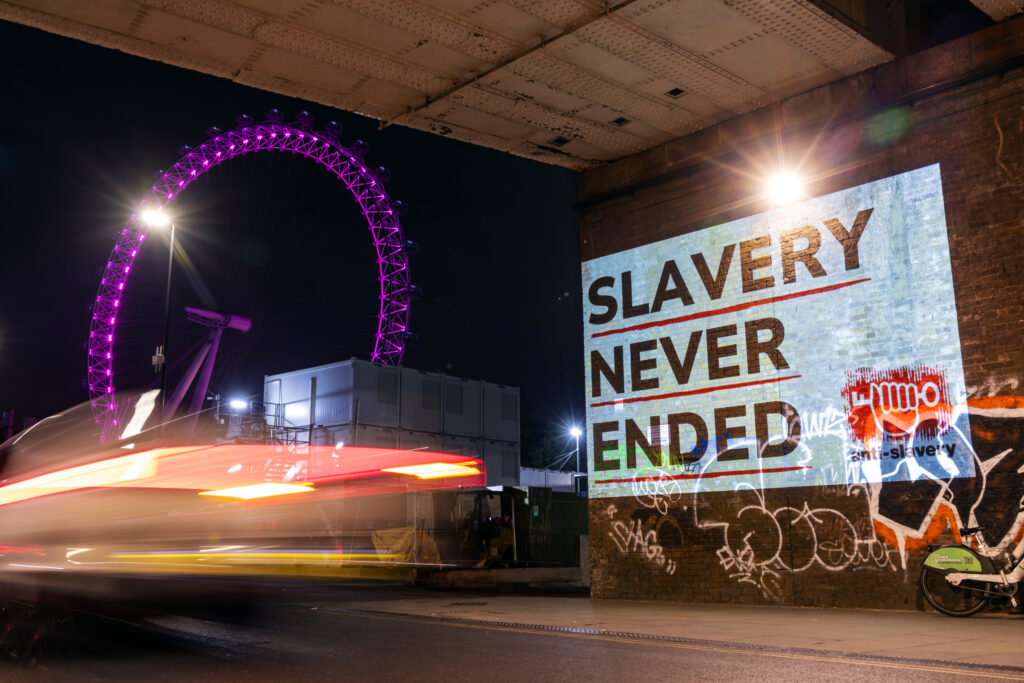
©Double Take Projections for Anti-Slavery International
In its two-hundredth anniversary edition in 2025, Anti-Slavery International’s Reporter, described many successes in the centuries-old struggle to eradicate slavery. But it also pointed out long-embedded injustices around the world that continue to this day, and many newer ways in which people are subject to loss of liberty and exploitation at work.
As its new interim CEO, I’m challenged to explore just what Anti-Slavery International’s role should be in this fast-changing world. A world where global trade, conflict, migration, digital connectivity and climate change, along with huge disparities of wealth between and within countries, are all part of perpetuating old and creating new forms of exploitation in modern slavery.
It is estimated that some 50 million people worldwide are living in slavery – more than at any time in human history. A harsh reminder of the endurance of a system of exploitation that many of us think has long been abolished. Anti-Slavery International works on just some of the many dimensions of this horror, but in my first month in this role, I’ve been amazed and challenged by the scale and breadth of the need.
What does slavery look like today?
State-imposed forced labour
There is a growing urgency to transition away from fossil fuels in the face of climate change. But we know that the solar industry is heavily implicated in forced labour in the Uyghur Region, where the Chinese Government is systematically persecuting Uyghur and other Turkic and Muslim-majority peoples, including through state-imposed forced labour. There are many other exports and practices from the Uyghur Region which are harder to trace so there is a need for ongoing research and investigation.
In Turkmenistan, cotton, much of which is exported, has traditionally been harvested with state-imposed forced labour. So Anti-Slavery International has worked with partners in the Cotton Campaign to pressure the Turkmenistan Government and European legislators and businesses to pass and implement laws to prevent this.
Migration and trafficking
While media attention has been focused on the harrowing trafficking and exploitation of, particularly women and girls, very little attention is focused on safeguarding and justice for survivors. Anti-Slavery International stands firmly with survivors, and we urge everyone to remember that behind every headline is a person.
Many migrants, so vilified in much of our media and political discourse, have fled the horrors of forced, indefinite military service, or been trafficked while attempting to escape poverty, have been trafficked into the UK to be forced to work in nail bars, or in cannabis production. Many also enter the country for falsely advertised jobs, only to be forced into sexual exploitation or criminality to pay off ever-increasing debts or under threat to their families at home.
As British political parties have competed to be tough on asylum and immigration, recognition that people being trafficked are not making free choices is being lost and progress in supporting those who are being enslaved is being pushed back. At the same time, the current focus on immigration enforcement rather than safeguarding has created vulnerabilities that lead people to exploitation.
So Anti-Slavery International works with others to better tell this story and promote legislation and policies that protect those most at risk. This includes joining legal action to give expert evidence.
We are proud to have played a part in a recent and important High Court case which found the current application of the public order disqualification unlawful. We have long opposed this provision introduced by the Nationality and Borders Act 2022, which was resulting in many survivors who were forced to commit offences as part of their exploitation to lose much needed support and protection essential to their recovery
Descent-based slavery and forced begging
Around the world, the practice of children being forced to beg to profit others sees children collecting money on the streets under the threat of violence.
Modern slavery also looks like, in some cases, people being born into slavery and ‘belonging’ to a family. People born into slavery face a lifetime of exploitation and are treated as property by their so-called ‘masters’ and can be sold and inherited.
In Niger and Mauritania, we work with local partners who are trying to tackle descent-based slavery and address forced child begging. In these situations, there must be a combination of strong laws, enforcement, and change to wider social attitudes, alongside practical support to ensure that people who have accessed freedom can get birth certificates, official registration, education, and opportunities to earn a living.
Business and human rights
There is a high risk that consumers around the world, including in the UK, are inadvertently buying goods made with forced labour. Consumers need to be able to trust what they are buying. Action to expose and prevent this is essential. We need the UK Government to take seriously its responsibility to protect people from modern slavery and to hold businesses accountable for failing to prevent harm, and to ensure that all businesses have to act in the way that the best already try to.
The UK’s 2015 Modern Slavery Act, while pioneering at the time, has proven ineffective in ensuring that businesses prevent modern slavery in their supply chains. We have been actively campaigning for the UK Government to step up its actions to tackle slavery to prevent the UK from becoming a dumping ground for products made with forced labour.
Anti-Slavery International has (successfully) lobbied the government to ensure there is no slavery in Great-British Energy’s supply chain as part of its Great British Energy Act 2025 , but it must go further and cover companies across industries. We need complementary import control and human rights due diligence laws that will compel all UK companies across all industries to clean up their supply chains is essential.
An important part of Anti-Slavery International’s work involves running an advisory service to help companies get their own policies and practices right along their supply chain, however far removed.
In the EU, Anti-Slavery International is a forceful part of a coalition fighting hard to prevent the roll-back of laws, including CSDDD, that entered into force in 2024. This deregulation effort has watered down key protections and are a blow for millions of workers around the world.
Emerging cases and the ever-changing face of modern slavery
As technology continues to develop, new forms of exploitation will continue to emerge around the world, some facilitated by AI, and others in the platform economy on digital platforms. Some of us have been on the receiving end of sophisticated telephone or digital scams. Many of them originate from massive centres in Southeast Asia, scam centres, where there have been many reports of people being trafficked from Africa and Asia and held in modern slavery. We are working to help people avoid being trafficked in this way through better awareness, using film and media.
Our challenge, our mission
These are just a few of the many different examples of what slavery looks like today, and some of the work that we are doing to challenge the structures that allow modern slavery to persist.
Anti-Slavery International had a very clear mission when it was founded back in1839. Nearly 200 years later that mission remains just as important. As a small charity and with so much needing to be done, as we continue to deliver valuable programmes, we need to work out just what role we are best equipped to play to help truly eradicate slavery.
That’s our challenge for the months ahead.