Slavery resources

Speak out about modern slavery
We have a host of resources available for individuals, schools and faith groups
Download our free resources to help raise awareness of modern slavery in your communities
Found 56 resources matching your current query.
Agents for change: survivor peer researchers bridge the evidence and inclusion gap (2020)
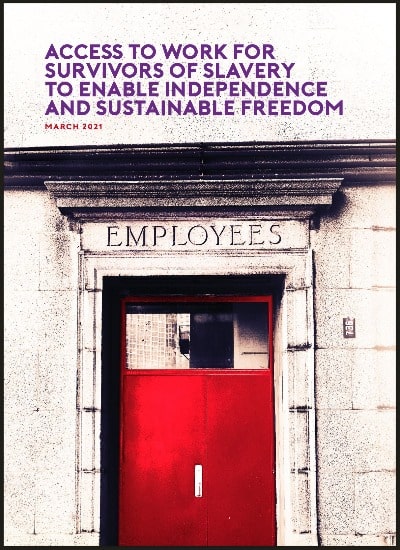
Access to work for survivors of slavery to enable independence and sustainable freedom
In order for survivors of modern slavery to recover from their exploitation, it’s essential the UK provides meaningful options to help them. This includes providing options to build independence and sustainable freedom through work, as well as through education, counselling and access to legal justice. This is a simple, achievable ask, which would do much to help survivors to move on from exploitation and to rebuild their lives. This report, produced by a coalition of organisations including Anti-Slavery International, examines the harm caused by denying survivors the right to work, as well as offering recommendations to make sure the National Referral Mechanism is reformed to allow people within the system to access work.
Joint briefing: Subsistence payments and legal aid eligibility for victims of trafficking: accessing one entitlement to lose another
People who are in the National Referral Mechanism for identifying victims of trafficking (NRM) are ‘entitled’ to legal aid. However legal aid is also means tested. This means not everyone in the NRM is able to access legal aid in practice. This poses a significant barrier to justice for people who are not eligible and denies them a key entitlement. We recommend that being in the NRM should also passport you through the legal aid income and capital tests. This would mean that everyone in the NRM would be able to access legal aid.
National Referral Mechanism multi-agency assurance panels: a review
This briefing reviews the provisions of the recently established Multi-Agency Assurance Panels (MAAPs) to date, assessing the extent to which they contribute to robust and transparent decision-making in the NRM. It focuses on the practical function of the MAAPs based on a survey conducted by ATMG in 2019, and feedback from 8 panellists. It goes on to highlight how this new approach to decision-making has revealed poor information sharing practices between relevant bodies, therefore undermining panel members’ ability to quality assure second stage negative decisions. In addition, it asks questions about victim support provisions more widely, especially for those engaging with the criminal justice system.
Written submission by members and endorsers of the Coalition to End Forced Labour in the Uyghur Region to the BEIS Committee consultation on Forced labour in UK value chains
This submission has been submitted on behalf of the 31 members and endorsers of the Coalition to End Forced Labour in the Uyghur Region, a coalition of over 280 Uyghur representative groups, civil society organisations, trade unions, faith-based groups and investors united to end state-sponsored forced labour and other egregious human rights abuses against people from the Uyghur Region in China, known to local people as East Turkistan.
Submission to BEIS Committee consultation on Forced labour in UK value chains:
Joint civil society response to the UK Government’s response to the Transparency in Supply Chains consultation
Our statement with 9 partner organisations responds to the Government’s response to the Transparency in Supply Chains consultation, published in September 2020. We argue that a lack of commitment to meaningful sanctions and enforcement measures is a major concern – and that much tougher government action is needed to tackle modern slavery and other human rights abuses in corporate supply chains.
Real lives, real people: ten years of advocacy for victims of slavery in the UK
ATMG, Anti-Slavery International.
This report aims to tell the story of how and why the Anti-Trafficking Monitoring Group (the ATMG) was formed in 2009, and the impact it has had over the last decade. It also aims to illustrate the coalition as a model for good practice in holding governments around the world to account through ‘critical friendship’. Over a decade, the ATMG’s approach has sought to question the UK Government’s efforts to combat slavery and trafficking, while at the same time offering a positive critique of their actions in order to improve the protection of victims of slavery and their rights.
Joint submission to the Group of Experts on Action against Trafficking in Human Beings
he submission on access to justice and effective remedies for victims of trafficking in human beings in the UK to the Group of Experts on Action against Trafficking in Human Beings (GRETA) on the implementation of the Council of Europe Convention on Action against Trafficking in Human Beings. The submission is to inform GRETA’s 3rd round evaluation of the UK and has been compiled by the Anti-Trafficking Monitoring Group (‘ATMG’), a coalition of twelve UK-based anti-trafficking organisations coordinated and chaired by Anti-Slavery International, from content submitted by ATMG members and ten other UK based organisations.
Although progress has been made by the UK in implementing the Council of Europe Convention, there is more to be done if the UK is to achieve its desired status as a world-leader in addressing human trafficking. The austerity cuts, which resulted in a systematic lack of funding for trafficking response programmes and prevented many trafficking survivors from obtaining specialist legal advice, and a tension between the implementation of anti-trafficking and immigration policies, which has undermined the UK’s ability to identify and support survivors, are amongst the biggest obstacles for the UK’s further progress.
COVID-19 and modern slavery victim support: joint letter to the Minister of Safeguarding
Joint letter from organisations within the anti-slavery sector to the UK Minister of Safeguarding asking for a clear plan and resourcing for survivor support in the context of COVID-19.
UN Human Rights Committee submission: modern slavery in the UK (2021)
The following report to the UN Human Rights Committee by Anti-Slavery International and nine other UK civil society organisations, assesses the UK Government’s response to trafficking and modern slavery, including the situation of trafficked children and migrant domestic workers.
While welcoming a number of significant and positive improvements to the law and policy framework addressing trafficking and modern slavery in the past few years, the report highlights critical gaps in the UK’s response. Obstacles persist in ensuring that victims are identified and protected, preventing survivors from being able to access the support needed to rebuild their lives away from slavery. The current Overseas Domestic Worker visa in place makes migrant domestic workers more vulnerable to abuse. Safeguards promised by the Government are not being implemented, and a fresh approach is needed to prevent their exploitation, including a return to, at minimum, the rights in place for migrant domestic workers prior to 2012. There are also significant gaps in the provision of care and support for child victims of trafficking, and the current identification system is not fit for purpose for child victims. Together, we call for a number of reforms to ensure that children and adults who have been trafficked or in modern slavery in the UK can be effectively identified, protected and supported, as well as having access to justice and remedy.