Every year, on the 18th of October, we commemorate Anti-Slavery Day. Anti-Slavery Day was created in 2010 to raise awareness of modern slavery and encourage shared action to eradicate slavery, because freedom is a fundamental right for everyone, everywhere, always.
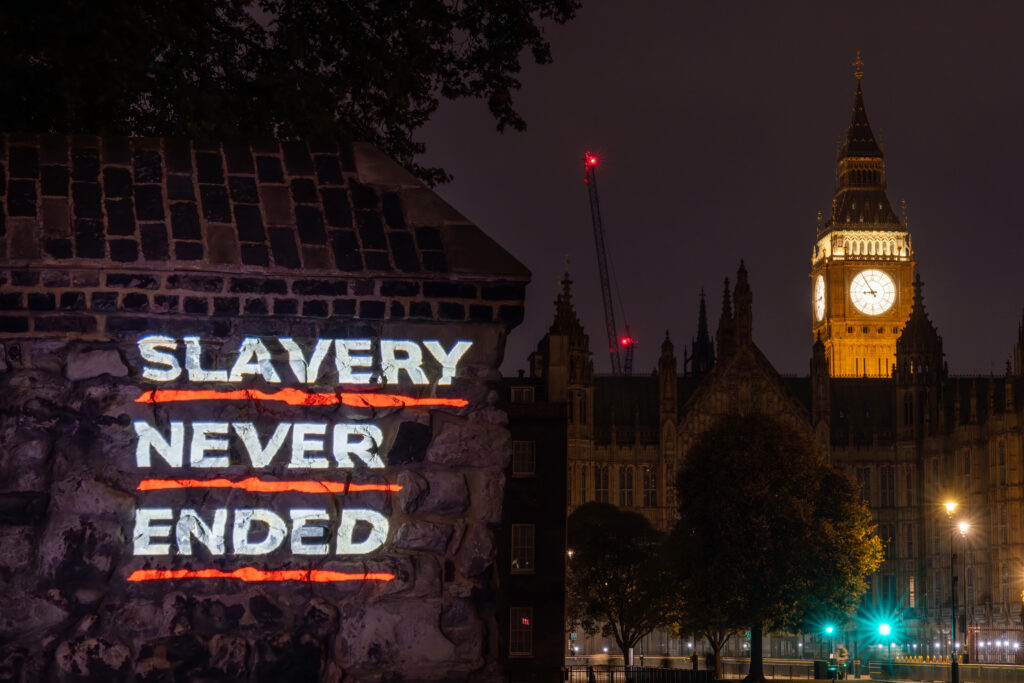
©Double Take Projections for Anti-Slavery International
In many ways, slavery today looks different to slavery of the Transatlantic Slave Trade. And while the ‘ownership’ of another person was abolished in every country in the world since 1981, issues like poverty, exclusion, and inadequate laws to protect people mean that slavery persists.
At Anti-Slavery International, we define modern slavery as the exploitation of an individual for personal or commercial gain. As a result, the person, who might have been tricked, coerced, or even forced into slavery, loses their freedom. People can become enslaved making the clothes we wear, harvesting the foods we eat, and producing the technology we use every day.
With an estimated 50 million people in situations of modern slavery today, we are starkly reminded that, despite the UK’s Slavery Abolition Act 1833 and the 1926 Slavery Convention, slavery persists. And it’s happening everywhere in the world, including where you live.
The legal abolition of slavery
The Slavery Abolition Act of 1833
Enslaved Africans led rebellions throughout the Transatlantic Slave Trade. Some movements were non-violent – many enslaved people refused to work, putting down their tools. Others were larger and riskier, involving, for example, burning plantations. With each act of resistance, enslaved people put their lives in danger in search of liberty.
These rebellions were key to the eventual passing of the UK’s 1833 Slavery Abolition Act across the British Empire, which ensured that people could no longer be bought, sold or owned in British colonies. Following the Act, over 800,000 Africans who had been kidnapped and enslaved were legally freed.
But the Act only provided partial liberation for enslaved people by:
- Compensating enslavers for ‘loss of property’, instead of people who were enslaved.
- Forcing survivors to become ‘apprentices’ for four to six years, and work for their former ‘owners’ for free.
The Act was a step in the right direction, but it was limited, and it did not end slavery around the world. Millions of people remained enslaved across other European colonies, the United States, Brazil, and more.
Anti-Slavery International, then known as the British and Foreign Anti-Slavery Society, was established in 1839 to campaign for abolition around the world.
The 1926 Slavery Convention
When the League of Nations and the International Labour Organization were set up in 1919, slavery had still not been abolished everywhere in the world. So, in 1926, nearly a century after the Slavery Abolition Act, the 1926 Slavery Convention emerged as an international standard against slavery. The Convention called on governments to end slavery “in all its forms”.
Ninety-nine countries have signed it since 1926. The Convention required countries to prevent slave trade in their waters, and abolish laws that allowed for enslavement.
The Slavery Convention also set some limits on the use of forced labour, but it was the International Labour Organization that presented the Forced Labour Convention in 1930 to ‘suppress the use of forced or compulsory labour in all its forms’.
Next year will mark the 100th anniversary of the Slavery Convention. When it was drafted, it reflected an international consensus on ending slavery and a recognition that it required international effort. But without strong enough laws to back it up, millions will remain trapped.
What do we mean by slavery never ended?
Despite continuing efforts, slavery persists. Today, some forms of modern slavery include human trafficking, forced labour, debt bondage, descent-based slavery (where people are born into slavery), child slavery, forced and early marriage, and domestic servitude.
Modern slavery is a continuation of a system rooted in history that has put profit over people’s dignity and well-being. Passing laws like the Slavery Abolition Act and more recent ones like the Modern Slavery Act 2015 in the UK, and the 1926 Convention, are important and necessary. But without addressing the root causes of slavery, like poverty and discrimination, it will continue. And current crises like climate change, war, famine, and even the recent pandemic are increasing the risk for millions of people around the world.

Join the movement
When we put our strength together, we can be powerful. We can dismantle systems of abuse, push for laws to be changed and amplify the voices of people who have experienced modern slavery.
The work continues
Throughout our history, we have come together with believers of freedom to campaign and advocate for a better world, free from slavery.
Since 2021, we advocated for the introduction of the EU Forced Labour Regulation , which entered into force in 2024. We campaigned to spread support for a human rights amendment to the Great British Energy Bill ensure that our clean energy is free from forced labour. And recently, we marched from Maastricht to Brussels in protest of the EU Commission’s Omnibus proposal.
But the work is not finished. This Anti-Slavery Day, we remember the 50 million people trapped in modern slavery today. Let’s make every day Anti-Slavery Day, until we can ensure that slavery ends. For everyone, everywhere, always.
Take action
Together, we can shine a light on hidden exploitation.
Tomorrow, on Anti-Slavery Day, we will take our campaign to one of the most visible places in the country: a powerful projection illuminating a landmark London building. The message will be clear: slavery never ended.
The projection will underscore a week of reflection, awareness, and action. And on Monday, we will host a panel discussion with leading human rights experts, activists, and academics to explore why slavery persists and how we can end it for good.
You can be part of this movement today: share the campaign, talk about modern slavery, and support our work to shine a light on exploitation. Images and highlights from the projection will be shared next week. Your continued support helps amplify the message.
Because freedom is a fundamental right for everyone, everywhere, always. Share the campaign, talk about modern slavery, and donate to support our work. Every action counts.
Share this blog with the hashtag #AntiSlaveryDay – let’s strengthen our campaign for freedom.