Slavery resources

Speak out about modern slavery
We have a host of resources available for individuals, schools and faith groups
Download our free resources to help raise awareness of modern slavery in your communities
Found 11 resources matching your current query.
A Business Briefing on Migrant Workers’ Access to Remedy
Legal guide: identification, rescue, rehabilitation and prosecution of bonded labour in the brick kiln industry
This guide is intended to equip activists with legal knowledge to eradicate the bonded labour system in India’s brick kiln industry. The brick kiln industry employs more than 10 million workers and is one of the bonded labour prone industries in India. Workers pawn their health, safety, social security, their children’s health and education in exchange for a bare sustenance. This guide provides tools for the identification, rescue, rehabilitation and prosecution of cases of bonded labour, focusing mainly on the implementation of the Bonded Labour Act and other applicable laws and procedures. It also suggests strategies that may be useful when dealing with the tough challenges faced in the process.
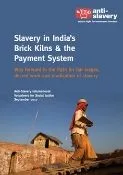
Slavery in India’s Brick Kilns & the Payment System: way forward in the fight for fair wages, decent work and eradication of slavery
Report revealing shocking levels of debt bondage and child slavery in brick kilns across Punjab. The report found that the recruitment and payment systems underpin this cycle of slavery, trapping seasonal migrant workers in bonded labour year after year, leaving women unpaid and not treated as workers, and encouraging child labour. It identified changing the piece-rate payment system into a time-based one, where workers are paid individually and regularly, as a systemic change that would help break the cycle of bonded and child labour.
Submission on bonded labour, trafficking and domestic work in India
UN’s Universal Periodic Review submission on bonded labour, trafficking and domestic work in India, 2016. The submission by Anti-Slavery International, Jan Jagriti Jendra, The National Domestic Workers’ Movement, and Volunteers for Social Justice.
2016 Submission on bonded labour, trafficking and domestic work in India
Anti-Slavery International, Jan Jagriti Jendra, The National Domestic Workers’ Movement, and Volunteers for Social Justice.
This submission to the Universal Periodic Review of India, focuses on slavery practices in India. These include bonded labour, which occurs across a variety of sectors; trafficking in persons within Indian borders; and the widespread abuse and exploitation of women working as domestic workers, including trafficking of children for domestic servitude. The submission also focuses on cases of trafficking and forced labour of workers migrating internationally. It is based on information gathered through a number of different projects in India by the above named organisations.
2016 Submission on bonded labour, trafficking and domestic work in India:
Joint submission for the Universal Periodic Review of Nepal, 23rd Session
Anti-Slavery International, Informal Sector Service Center (INSEC) & Backward Society Education (BASE)
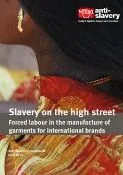
Slavery on the high street. Forced labour in the manufacture of garments for international brands.
Anti-Slavery International.
New report from Anti-Slavery International exposes how top UK high street brands are selling clothing made by girls in slavery in southern India. Our research has uncovered the routine use of forced labour of girls and young women in the spinning mills and garment factories of five Indian clothing manufacturers that supply major western clothing retail brands.
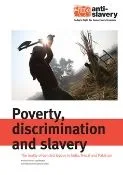
Poverty, Discrimination and Slavery: The reality of bonded labour in India, Nepal and Pakistan
Anti-Slavery International, Krishna Prasad Upadhyaya.
This report is a study of the reasons why bonded labour, a contemporary form of slavery, persists in India, Nepal and Pakistan. In particular, it examines the effectiveness of state interventions against bonded labour. This report reflects the main findings of research carried out by CEC, GEFONT and PILER between 2004 and 2006 into some of the obstacles to the eradication of bonded labour, the reasons why bonded labour persists, and into the interventions that have been made since anti-bonded legislation came into force in South Asia. It includes a number of recommendations which if fully implemented would lead to the eradication of bonded labour in South Asia. ISBN: 978-0-900918-70-4.

Poverty, Development and the Elimination of Slavery
Anti-Slavery International, Mike Kaye, Aidan McQuade
Discussion paper.