Slavery resources

Speak out about modern slavery
We have a host of resources available for individuals, schools and faith groups
Download our free resources to help raise awareness of modern slavery in your communities
Found 60 resources matching your current query.
Parliamentary briefing: Immigration and Asylum Bill second reading
The Immigration and Asylum Bill will significantly weaken the UK’s response to trafficking and modern
slavery. It will deny access to identification, protection, support and recovery to many survivors. This
approach punishes survivors, will embolden traffickers and in doing so enable exploitation to thrive,
harming individuals, communities and our economy
Open letter on the UK Immigration White Paper
A letter on behalf of 33 organisations across the Modern Slavery sector, condemning the divisive and hostile rhetoric from the UK Government and expressing deep concern at the policy on immigration announced in the White Paper.
Joint Submission to the Group of Experts on Action against Trafficking in Human Beings
Response to the Fourth Evaluation Round of the Questionnaire for the evaluation of the implementation of the Council of Europe Convention on Action against Trafficking in Human Beings
Excerpt from Executive Summary:
Since GRETA’s third evaluation round in 2020, the United Kingdom has regrettably taken many steps back in tackling vulnerabilities to trafficking and modern slavery.
Contributors to this joint submission have identified the UK Government’s focus on immigration enforcement and securitisation as the main barrier to developing a strong prevention response and the cause of the erosion of the identification and support mechanisms for survivors of modern slavery. Independent monitoring mechanisms, such as the Home Affairs Select Committee, have expressed deep concerns in relation to the UK Government’s de-prioritisation of human trafficking in favour of a focus on irregular migration. More recently, the Lords Select Committee published their report following their inquiry into the Modern Slavery Act 2015, which found that immigration legislation has limited the support which the Act originally afforded to survivors, leaving them vulnerable and without adequate protection from their traffickers.
Submission by:
After Exploitation, Anti-Trafficking Monitoring Group, Anti Trafficking and Labour Exploitation Unit (ATLEU), British Red Cross (BRC), Every Child Protected Against Trafficking UK (ECPAT UK), Focus on Labour Exploitation (FLEX), Hestia, Hope for Justice, Human Trafficking Foundation & Lived Experience Advisory Panel, International Organization for Migration, Country office for the United Kingdom of Great Britain and Northern Ireland (IOM UK), Latin American, Women’s Rights Service (LAWRS), Taskforce on Survivors of Trafficking in Immigration Detention (Detention Taskforce), The Passage, The Salvation Army, The UK BME Anti-Slavery Network (BASNET), Unseen UK.
As UN Experts express alarm, coalition calls on the Government to end hostility towards survivors of trafficking and modern slavery
Today, UN experts expressed alarm at the UK Government’s use of unevidenced claims and sensationalist language towards survivors of trafficking and modern slavery, stating these attacks on the credibility of survivors and their legal representatives have a “chilling effect.” Following this release, twenty one anti-slavery organisations have released a statement calling on the Government to end its roll-back of rights and protection for survivors, and recommit to support, assistance and safeguarding for all victims of this grave crime.
Online Safety Bill Briefing
Anti-Slavery International. The brief provides parliamentarians with an overview of the relationship between human trafficking and online safety and outlines concerns and recommendations relating to the Bill.
Download the briefing:

One day at a time: reviewing the Recovery Needs Assessment (RNA) (2022)
“One day at a time” looks at the experience of the Recovery Needs Assessment (RNA) process. It charters the first-hand experiences of, not only those on the receiving end of support, but also the experiences of Modern Slavery Victim Care Contract (MSVCC) support providers, along with, support workers outside of the MSVCC.
Joint UN universal periodic review submission: trafficking and modern slavery in the UK (2022)
Research and analysis from the anti-trafficking sector has demonstrated the considerable shortcomings within the UK’s anti-trafficking framework, failing victims and survivors of trafficking.
The UK government has tended to view trafficking and modern slavery as a discrete form of abuse rather than existing at the extreme end of a continuum of exploitation. Working conditions must be improved generally to avoid situations degrading to the stage where they amount to human trafficking. Strengthening the labour market enforcement can help to embed a model based on proactive protection rather than simply redress once a situation has degraded to a sufficient level of severity.
This joint submission looks at the impacts of the UK’s immigration enforcement-centred approach, current obstacles in the identification and protection of victims of trafficking and modern slavery and provides a series of recommendations.
Joint Submission for the Universal Periodic Review of the UK – Migrant Domestic Workers
Anti-Slavery International, Dignity at Work, Focus on Labour Exploitation, Kalayaan, Kanlungan, and The Voice of Domestic Workers.
Migrant domestic workers in the UK – the majority of whom are women – continue to suffer from widespread abuse and exploitation, including situations of trafficking and modern slavery. The Overseas Domestic Worker visa increases vulnerability to exploitation as it restricts migrant domestic workers to a non-renewable six-month visa. While there are mechanisms in place to identify and provide support to victims of trafficking and modern slavery in the UK, these only apply to migrant domestic workers whose treatment amounts to the legal definition of trafficking and modern slavery. Ahead of the 2022 Universal Periodic Review of the UK, Anti-Slavery International, along with other organisations, submitted evidence relating to migrant domestic workers in the UK.
Joint Submission for the the Universal Periodic Review of the UK:
UN universal periodic review submission: migrant domestic workers in the UK (2022)
Migrant domestic workers in the UK, the majority of whom are women that live in their employer’s household, continue to suffer from widespread abuse and exploitation, including situations of trafficking and modern slavery
This is a joint submission by Anti-Slavery International, Focus on Labour Exploitation (FLEX), Kalayaan, Kanlungan Filipino Consortium, and the Voice of Domestic Workers. The submission focuses on abuse and exploitation, including trafficking and modern slavery, of migrant domestic workers in the UK.
The Overseas Domestic Worker visa increases vulnerability to exploitation because it restricts migrant domestic workers to a non-renewable six-month visa, against the recommendations of an independent review commissioned by the Government itself3. The inability to renew the visa renders the right to change employer inaccessible in practice and leaves migrant domestic workers to face abuse and exploitation with no escape route. It also obstructs access to justice and remedy when abuse occurs. New protections for migrant domestic workers announced by the Government in 2016 have either been dropped altogether or are not being implemented in practice.
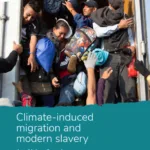
Climate-induced migration and modern slavery
Anti-Slavery International partnered with the International Institute for Environment and Development (IIED) to publish a report exposing the relationship between climate change, forced migration and modern slavery. The report finds that climate change heightens existing vulnerabilities of slavery and that there are three emerging pathways linking climate change, migration and modern slavery: sudden events in the aftermath of disasters, slow onset events/disasters, and slow onset events combined with conflict and forced displacement.