Slavery resources

Speak out about modern slavery
We have a host of resources available for individuals, schools and faith groups
Download our free resources to help raise awareness of modern slavery in your communities
Found 59 resources matching your current query.
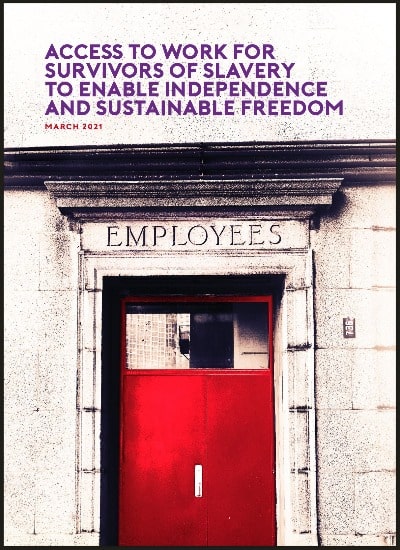
Access to work for survivors of slavery to enable independence and sustainable freedom
Joint briefing: Subsistence payments and legal aid eligibility for victims of trafficking: accessing one entitlement to lose another
People who are in the National Referral Mechanism for identifying victims of trafficking (NRM) are ‘entitled’ to legal aid. However legal aid is also means tested. This means not everyone in the NRM is able to access legal aid in practice. This poses a significant barrier to justice for people who are not eligible and denies them a key entitlement. We recommend that being in the NRM should also passport you through the legal aid income and capital tests. This would mean that everyone in the NRM would be able to access legal aid.
National Referral Mechanism multi-agency assurance panels: a review
This briefing reviews the provisions of the recently established Multi-Agency Assurance Panels (MAAPs) to date, assessing the extent to which they contribute to robust and transparent decision-making in the NRM. It focuses on the practical function of the MAAPs based on a survey conducted by ATMG in 2019, and feedback from 8 panellists. It goes on to highlight how this new approach to decision-making has revealed poor information sharing practices between relevant bodies, therefore undermining panel members’ ability to quality assure second stage negative decisions. In addition, it asks questions about victim support provisions more widely, especially for those engaging with the criminal justice system.
Real lives, real people: ten years of advocacy for victims of slavery in the UK
ATMG, Anti-Slavery International.
This report aims to tell the story of how and why the Anti-Trafficking Monitoring Group (the ATMG) was formed in 2009, and the impact it has had over the last decade. It also aims to illustrate the coalition as a model for good practice in holding governments around the world to account through ‘critical friendship’. Over a decade, the ATMG’s approach has sought to question the UK Government’s efforts to combat slavery and trafficking, while at the same time offering a positive critique of their actions in order to improve the protection of victims of slavery and their rights.
Joint submission to the Group of Experts on Action against Trafficking in Human Beings
he submission on access to justice and effective remedies for victims of trafficking in human beings in the UK to the Group of Experts on Action against Trafficking in Human Beings (GRETA) on the implementation of the Council of Europe Convention on Action against Trafficking in Human Beings. The submission is to inform GRETA’s 3rd round evaluation of the UK and has been compiled by the Anti-Trafficking Monitoring Group (‘ATMG’), a coalition of twelve UK-based anti-trafficking organisations coordinated and chaired by Anti-Slavery International, from content submitted by ATMG members and ten other UK based organisations.
Although progress has been made by the UK in implementing the Council of Europe Convention, there is more to be done if the UK is to achieve its desired status as a world-leader in addressing human trafficking. The austerity cuts, which resulted in a systematic lack of funding for trafficking response programmes and prevented many trafficking survivors from obtaining specialist legal advice, and a tension between the implementation of anti-trafficking and immigration policies, which has undermined the UK’s ability to identify and support survivors, are amongst the biggest obstacles for the UK’s further progress.
UN Human Rights Committee submission: modern slavery in the UK (2021)
The following report to the UN Human Rights Committee by Anti-Slavery International and nine other UK civil society organisations, assesses the UK Government’s response to trafficking and modern slavery, including the situation of trafficked children and migrant domestic workers.
While welcoming a number of significant and positive improvements to the law and policy framework addressing trafficking and modern slavery in the past few years, the report highlights critical gaps in the UK’s response. Obstacles persist in ensuring that victims are identified and protected, preventing survivors from being able to access the support needed to rebuild their lives away from slavery. The current Overseas Domestic Worker visa in place makes migrant domestic workers more vulnerable to abuse. Safeguards promised by the Government are not being implemented, and a fresh approach is needed to prevent their exploitation, including a return to, at minimum, the rights in place for migrant domestic workers prior to 2012. There are also significant gaps in the provision of care and support for child victims of trafficking, and the current identification system is not fit for purpose for child victims. Together, we call for a number of reforms to ensure that children and adults who have been trafficked or in modern slavery in the UK can be effectively identified, protected and supported, as well as having access to justice and remedy.
Precarious Journeys: mapping vulnerabilities of victims of trafficking from Vietnam to Europe
ECPAT, Anti-Slavery International, Pacific Links Foundation.
This research was conducted by Every Child Protected Against Trafficking (ECPAT UK), Anti-Slavery International (Anti-Slavery) and Pacific Links Foundation (Pacific Links). Over one and a half years the research investigated the issue of human trafficking from Vietnam to the UK, and through Europe; specifically Poland, the Czech Republic, France and the Netherlands to the UK. This report summarises the main findings of the research. It highlights that whilst there are many vulnerabilities which result in a person leaving Vietnam, vulnerabilities are not inherent in all Vietnamese migrants. Situational and contextual factors can increase vulnerability and risk of trafficking across all aspects of a migrant’s journey from Vietnam to Europe.
Joint submission to the UN Committee on the Elimination of all forms of Discrimination against Women – on the UK
This joint submission to the Committee on the Elimination of all forms of Discrimination against Women by five civil society organisations: Anti-Slavery International, the Anti Trafficking and Labour Exploitation Unit (ATLEU), the Anti-Trafficking Monitoring Group (ATMG), the Human Trafficking Foundation (HTF), and Kalayaan, outlines gaps in UK’s response to modern slavery: including the identification, protection and support provided to victims; barriers in access to legal advice, justice and remedy; and flaws in the legal and policy framework relating to migrant domestic workers, which renders them particularly vulnerable to abuse, exploitation, and trafficking.
Places of safety: principles that underpin early support provision for survivors of trafficking
Red Cross, Anti-Trafficking Monitoring Group (ATMG), ATLEU, Human Trafficking Foundation.
The Anti-Trafficking Monitoring Group, along with The British Red Cross, ATLEU and The Human Trafficking Foundation have produced a list of 10 core principles in a new guide for services providing Places of Safety and early support for adult survivors. These 10 principles, when taken together, are the minimum standards that are required if Places of Safety are to meet their intended purpose. The principles are complementary and each one is necessary: the absence of any of the principles puts at risk the victim-centred nature of any service. Places of Safety need to be able to evidence their ability to operate a truly victim-centred service. Services should meet national and international legal standards and be able to demonstrate competence.
Trafficking survivor care standards
Human Trafficking Foundation (with input from the Anti-Trafficking Monitoring Group)
The trafficking survivor care standards were developed in conjunction with experts in the anti trafficking sector with the aim of providing a blueprint for uk-wide service providers offering high quality care to adult survivors of modern slavery, including trafficking. The standards provide a flexible framework with guiding principles and practical recommendations that support agencies can incorporate into their own existing policies and procedures. The ultimate goal is to promote an integrated, holistic and empowering approach that places the real needs of survivors at the centre of the process of sustained recovery, far beyond the ‘reflection period’.