Slavery resources

Speak out about modern slavery
We have a host of resources available for individuals, schools and faith groups
Download our free resources to help raise awareness of modern slavery in your communities
Found 35 resources matching your current query.
Joint submission to the UN Special Rapporteur on contemporary forms of slavery – state imposed forced labour in the Uyghur region
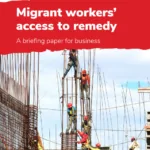
A Business Briefing on Migrant Workers’ Access to Remedy
As an integral part of their workforce, in operations and supply chains, companies should take steps to make sure migrant workers’ rights are respected and upheld. This must include steps to improve access to effective remedy for migrant workers, including by understanding and addressing the underlying drivers of exploitation and barriers migrant workers face when seeking remedy. This report guides companies on how they can support migrant workers’ access to remedy.
Principal elements of a UK corporate duty to prevent adverse human rights and environmental impacts – A ‘failure to prevent’ law
A coalition of civil society organisations is calling for the introduction a new UK ‘mandatory human rights and environmental due diligence’ law, based on the duties to prevent tax evasion and bribery found in the Criminal Finances Act 2017 and the Bribery Act 2010 – as called for by the UK Parliament’s Joint Committee on Human Rights, and found to be legally feasible by the British Institute of International and Comparative Law.
These principles for a new law have been prepared by UK civil society organisations who are working to strengthen corporate accountability for human rights abuses, including modern slavery, and environmental damage. It provides an overview of the principle elements needed in such new legislation.
The principles are endorsed by over 30 individual UK organisations, including Anti-Slavery International.
EU law. Global impact. A report considering the potential impact of human rights due diligence laws on labour exploitation and forced labour
The European Commission will soon publish a proposal for an EU business and human rights law that would require companies operating in the EU to prevent and address human rights abuses and environmental damage in their global supply chains. This commitment to mandatory human rights and environmental due diligence could help tackle forced labour and child labour in supply chains around the world.
On 28 June 2021, we published new research, undertaken by the Rights Lab, University of Nottingham, to understand how the upcoming EU business and human rights law could affect workers’ human rights through two case studies: the leather industry in India, and the coffee industry in Brazil.
Anti-Slavery International and European Center for Constitutional and Human Rights’ position on import controls to address forced labour in supply chains
Following the G7 Summit in Carbis Bay, we, together with the European Centre for Constitutional and Human Rights, have published a position paper on when and how governments should introduce import controls to end forced labour. Import controls should not be the only measure used to address forced labour in global supply chains. Instead, they should be introduced as part of strong legal, trade and development framework to address the root causes of forced labour – poverty, lack of legal protection, worker representation and discrimination. In particular, we have worked for many years to call for the introduction of stronger laws such as mandatory human rights and environmental due diligence (mHREDD), and we believe that the two approaches – mHREDD and import controls – are complementary. Although specifically concerned with developments in the EU, this position paper is applicable to all governments.
From a vicious to a virtuous circle: Addressing climate change, environmental destruction and contemporary slavery
Climate change is a global crisis with serious implications for all of humanity. For people who are vulnerable to exploitation, it can be especially serious: climate change can drive a vicious circle that traps people into working in industries that contribute to environmental harms, which can in turn intensify the conditions that leave people vulnerable. In our research report, author Dr Chris O’Connell, CAROLINE Fellow at Dublin City University, examines the causes and effects of climate-linked modern slavery, and identifies practical recommendations for policy makers to tackle the problem.
Anti-Slavery International’s submission to the European Commission consultation for an initiative on sustainable corporate governance (mHREDD)
Anti-Slavery International response to the public consultation on the need and objectives for EU intervention on sustainable corporate governance. We took part in this consultation, together with partner organisations in more than 20 countries, including Bangladesh, Brazil, Chile, Colombia, Ghana, India, Indonesia, Nepal, South Africa and Turkmenistan. We also actively encouraged our supporters and allies to do the same, and we want to thank everyone who took part: this consultation proved to the European Commission that people all over the world look to the EU to show leadership, courage and compassion for oppressed people everywhere.
Written submission by members and endorsers of the Coalition to End Forced Labour in the Uyghur Region to the BEIS Committee consultation on Forced labour in UK value chains
This submission has been submitted on behalf of the 31 members and endorsers of the Coalition to End Forced Labour in the Uyghur Region, a coalition of over 280 Uyghur representative groups, civil society organisations, trade unions, faith-based groups and investors united to end state-sponsored forced labour and other egregious human rights abuses against people from the Uyghur Region in China, known to local people as East Turkistan.
Submission to BEIS Committee consultation on Forced labour in UK value chains:
Joint civil society response to the UK Government’s response to the Transparency in Supply Chains consultation
Our statement with 9 partner organisations responds to the Government’s response to the Transparency in Supply Chains consultation, published in September 2020. We argue that a lack of commitment to meaningful sanctions and enforcement measures is a major concern – and that much tougher government action is needed to tackle modern slavery and other human rights abuses in corporate supply chains.
What if? Case studies of human rights abuses and environmental harm linked to EU companies, and how EU due diligence laws could help protect people and the planet
Anti-Slavery International and ECCJ
ECCJ’s and Anti-Slavery International’s report details a number of case studies where EU-based companies have failed to address corporate abuse and environmental harm in their global value chains, profited from it, and so far managed to avoid liability before the courts.
The case studies clearly demonstrate how EU wide mandatory cross-sectoral human rights and environmental due diligence legislation, with improved access to remedy rules, would make a difference in these cases. Only by introducing binding legislation can we truly protect people and the planet, tackle human rights and environmental abuses linked to European operations, products and services, and finally hold out-of-control EU-based companies to account.
Now is the time to make it happen.