Slavery resources

Speak out about modern slavery
We have a host of resources available for individuals, schools and faith groups
Download our free resources to help raise awareness of modern slavery in your communities
Found 35 resources matching your current query.
Principal elements for an EU mandatory human rights and environmental due diligence law
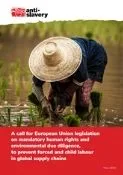
European Union proposed legislation on mandatory human rights and environmental due diligence – policy paper
Anti-Slavery International.
Anti-Slavery International, along with a large coalition of NGOs and trade unions, is calling on the European Commission to introduce EU-wide human rights and environmental due diligence legislation. This law would require companies and financial institutions to identify, prevent, mitigate and account for human rights abuses and environmental damage caused by their operations, subsidiaries and value chains. This policy paper outlines why the legislation is important to prevent forced and child labour in global supply chains and Anti-Slavery International’s recommendations to the European Union and its member states on the legislation.
A call to action from over 100 NGOs for EU human rights and environmental due diligence legislation
Over 100 civil society organisations and trade unions have called on the European Union to bring forth this term new corporate accountability legislation requiring companies to respect human rights and the environment in their global value chains and operations. Such legislation should establish a corporate duty to respect human rights and the environment and require companies and financial institutions to identify, prevent, mitigate and account for abuses and harm in their domestic and global operations, activities, products, services, supply chains and exports. The legislation should hold such companies legally accountable and provide access to justice for victims.
Anti-Slavery has been leading this action, together with NGO partners including Clean Clothes Campaign and the European Coalition for Corporate Justice.
A call for EU human rights and environmental due diligence legislation:
Submission to the UK government on the UK Transparency in Supply Chains Clause of the Modern Slavery Act
Submission by CORE Coalition, Anti-Slavery International, Amnesty International, Business and Human Rights Resource Centre, Christian Aid, Environmental Justice Foundation, Fairtrade Foundation, FLEX, Freedom Fund, Freedom United, Traidcraft Exchange, TUC, UNICEF and UNISON.
We’re calling on the UK government to:
- Introduce mandatory criteria for reporting
- Introduce an effective Government-run registry
- Introduce meaningful sanctions for failures to comply with the TISC provision
- Extend the reporting requirement to the public sector
- For the UK government to go beyond reporting and introduce mandatory human rights due diligence.
Briefing for Westminster Hall Debate on the independent review of the Modern Slavery Act
Improving the effectiveness of the supply chain reporting requirement in UK Modern Slavery Act 2015 and moving towards mandatory human rights due diligence. This review considers the successes and limitations of the implementation of the reporting requirements set out in the UK Modern Slavery Act to reducing modern slavery in supply chains. The review identifies that research by civil society and reports by Parliamentary committees have exposed flaws in the legislation and its implementation.
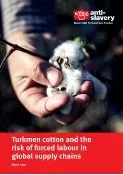
Turkmen cotton and the risk of forced labour in global supply chains
This report brings the strong links between Turkey and Turkmenistan to light. Being the 11th largest cotton producer in the world, Turkmenistan’s apparel and textile exports pose a significant risk of forced labour tainting global supply chains and present a challenge to brands’ due diligence. Anti-Slavery International has documented cases of Turkish enterprises that operate in Turkmenistan and claim to sell their products to well-known international brands. These links show that Turkey is acting as the main gateway for its cotton products to global supply chains, and brands should be aware of it.
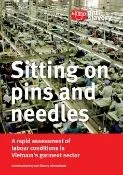
Sitting on pins and needles report
This report is a rapid assessment of labour conditions in Vietnam’s export-oriented textile and garment sector. The findings of the report, that highlight the risk of forced labour, child labour and child slavery, showcase the need for pan-European legislation that includes mandatory human rights due diligence at the EU level. As the second largest garment producer in Asia, and key trading partner of the EU, the Vietnam case was worth looking at. With Vietnam and the EU in the middle of negotiations on a future trade agreement, this study proves the EU should set higher standards for those it chooses to trade with.
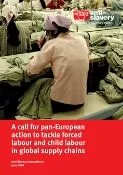
A call for pan-European action to tackle forced labour and child labour in global supply chains
This briefing for European policy makers outlines the increased risk of forced and child labour, in global supply chains of goods and services. It argues that extant national and EU law and policies are insufficient to eradicate slavery in supply chains, since they cover only specific sectors (such as conflict minerals or timber) or generic transparency requirements. Anti-Slavery International calls for a systematic, pan-European approach to tackling forced and child labour in global supply chains that includes binding due diligence, requiring businesses to proactively tackle human rights abuses throughout their supply chains.
Slavery on the high street. Forced labour in the manufacture of garments for international brands.
Anti-Slavery International.
New report from Anti-Slavery International exposes how top UK high street brands are selling clothing made by girls in slavery in southern India. Our research has uncovered the routine use of forced labour of girls and young women in the spinning mills and garment factories of five Indian clothing manufacturers that supply major western clothing retail brands.

‘Never Work Alone’: Trade Unions and NGOs joining forces to combat Forced Labour and Trafficking in Europe
‘Never Work Alone’ is a guide for trade unions and other civil society organisations to jointly combat modern-day slavery and trafficking of workers. The report is the result of a two-year project in which trade unions and NGOs have looked into each other’s actions and approaches to combat slavery and labour trafficking. It examines different approaches and shows four major common grounds for action, each of them documented with a series of best practices.