Slavery resources

Speak out about modern slavery
We have a host of resources available for individuals, schools and faith groups
Download our free resources to help raise awareness of modern slavery in your communities
Found 32 resources matching your current query.
Parliamentary briefing: Immigration and Asylum Bill second reading
The Immigration and Asylum Bill will significantly weaken the UK’s response to trafficking and modern
slavery. It will deny access to identification, protection, support and recovery to many survivors. This
approach punishes survivors, will embolden traffickers and in doing so enable exploitation to thrive,
harming individuals, communities and our economy
A Training Framework for Local Authorities as Modern Slavery First Responders in England and Wales
Modern Slavery (MS) is a serious and growing issue. Local Authorities (LAs) play a key role in identifying and supporting survivors. However, many LAs face challenges in fully adopting their legal responsibilities as First Responders (FRs).
Following the publication in May 2025 of research on LAs’ implementation of their First Responder responsibilities (see key findings below) and the development of a preliminary training framework, the Middlesex University research team, in partnership with the Anti-Trafficking Monitoring Group (ATMG), held further consultations with LAs, NGOs, and lived experience experts to strengthen and refine this framework.
The finalised training framework, published in February 2026, sets out core guiding principles, a four-tier training structure (from awareness to leadership), and practical recommendations for implementation, designed as a flexible, adaptable structure, rather than a prescriptive curriculum to support councils in developing context-specific, survivor-centred training programmes.
The study identified several barriers and areas for improvement:
- Limited awareness and training: Many LAs staff are unaware of their role as FRs. Training, where available, is often inconsistent and not tailored to local needs. Some staff assume that only the police can deal with MS cases.
- Fragmented responses: While some councils have strong MS policies, others lack clear processes for identifying and supporting survivors. This results in an inconsistent approach across different regions.
- Barriers to multi-agency working: Effective MS response requires collaboration between LAs, law enforcement, and community groups. However, miscommunication, lack of trust, and unclear responsibilities hinder joint efforts.
- Gaps in supply chain oversight: LAs have a legal duty to monitor their supply chains for potential exploitation, but reporting is inconsistent and many councils lack the resources to conduct thorough checks.
- Examples of good practice: Some LAs have developed strong partnerships with community organisations, invested in specialist MS teams, and introduced innovative training approaches. These examples highlight what is possible with the right strategies in place.
This report was produced by Middlesex University in partnership with the Anti-Trafficking Monitoring Group.
The Development of a Preliminary Training Framework for Local Authorities as Modern Slavery First Responders in England and Wales
Modern Slavery (MS) is a serious and growing issue in England and Wales and Local Authorities (LAs) play a key role in identifying and supporting survivors. However, many LAs face challenges in fully adopting their legal responsibilities as First Responders (FRs). This report explores these challenges and opportunities, focusing on improving training, awareness, and collaboration to strengthen the local response to MS.
The study identified several barriers and areas for improvement:
- Limited awareness and training: Many LAs staff are unaware of their role as FRs. Training, where available, is often inconsistent and not tailored to local needs. Some staff assume that only the police can deal with MS cases.
- Fragmented responses: While some councils have strong MS policies, others lack clear processes for identifying and supporting survivors. This results in an inconsistent approach across different regions.
- Barriers to multi-agency working: Effective MS response requires collaboration between LAs, law enforcement, and community groups. However, miscommunication, lack of trust, and unclear responsibilities hinder joint efforts.
- Gaps in supply chain oversight: LAs have a legal duty to monitor their supply chains for potential exploitation, but reporting is inconsistent and many councils lack the resources to conduct thorough checks.
- Examples of good practice: Some LAs have developed strong partnerships with community organisations, invested in specialist MS teams, and introduced innovative training approaches. These examples highlight what is possible with the right strategies in place.
This report was produced by Middlesex University in partnership with the Anti-Trafficking Monitoring Group.
Safe homes: Ensuring access to safe accommodation for survivors of modern slavery
This briefing by The Anti-trafficking Monitoring Group (ATMG) and Hope at home “Safe Homes” analyses some of the obstacles and gaps in support potential and confirmed survivors of modern slavery in asylum accommodations face when evicted because of becoming eligible to apply for social housing.
Non-Statutory First Responder Capacity 2024
This briefing aims to give an updated overview on the situation of non-statutory First Responders in their ability to refer potential survivors of modern slavery into the NRM in the 6 months between December 2023 and June 2024. The analysis has found an ongoing capacity issue affecting non-statutory First Responders, which are under considerable pressure. This is having detrimental consequences on survivors of trafficking and modern slavery, who are experiencing delays to access identification, support and protection.

One day at a time: reviewing the Recovery Needs Assessment (RNA) (2022)
“One day at a time” looks at the experience of the Recovery Needs Assessment (RNA) process. It charters the first-hand experiences of, not only those on the receiving end of support, but also the experiences of Modern Slavery Victim Care Contract (MSVCC) support providers, along with, support workers outside of the MSVCC.
Joint UN universal periodic review submission: trafficking and modern slavery in the UK (2022)
Research and analysis from the anti-trafficking sector has demonstrated the considerable shortcomings within the UK’s anti-trafficking framework, failing victims and survivors of trafficking.
The UK government has tended to view trafficking and modern slavery as a discrete form of abuse rather than existing at the extreme end of a continuum of exploitation. Working conditions must be improved generally to avoid situations degrading to the stage where they amount to human trafficking. Strengthening the labour market enforcement can help to embed a model based on proactive protection rather than simply redress once a situation has degraded to a sufficient level of severity.
This joint submission looks at the impacts of the UK’s immigration enforcement-centred approach, current obstacles in the identification and protection of victims of trafficking and modern slavery and provides a series of recommendations.
UN universal periodic review submission: migrant domestic workers in the UK (2022)
Migrant domestic workers in the UK, the majority of whom are women that live in their employer’s household, continue to suffer from widespread abuse and exploitation, including situations of trafficking and modern slavery
This is a joint submission by Anti-Slavery International, Focus on Labour Exploitation (FLEX), Kalayaan, Kanlungan Filipino Consortium, and the Voice of Domestic Workers. The submission focuses on abuse and exploitation, including trafficking and modern slavery, of migrant domestic workers in the UK.
The Overseas Domestic Worker visa increases vulnerability to exploitation because it restricts migrant domestic workers to a non-renewable six-month visa, against the recommendations of an independent review commissioned by the Government itself3. The inability to renew the visa renders the right to change employer inaccessible in practice and leaves migrant domestic workers to face abuse and exploitation with no escape route. It also obstructs access to justice and remedy when abuse occurs. New protections for migrant domestic workers announced by the Government in 2016 have either been dropped altogether or are not being implemented in practice.

Agents for change: survivor peer researchers bridge the evidence and inclusion gap (2020)
Agents for Change is a briefing that shares reflections on the lessons and challenges of a small research team originally formed to conduct research on long-term outcomes for survivors of slavery in the UK in 2020. The team consisted of three women with lived experience of modern slavery and the Anti-Trafficking Monitoring Group (ATMG). Co-written by survivors and non-survivors of slavery or exploitation, this briefing shares collective and individual reflections on the process of working and learning together to date.
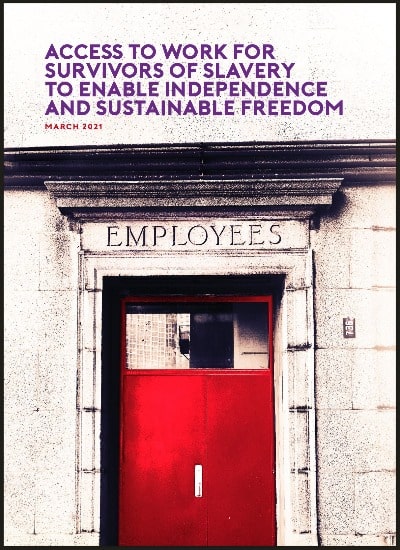
Access to work for survivors of slavery to enable independence and sustainable freedom
In order for survivors of modern slavery to recover from their exploitation, it’s essential the UK provides meaningful options to help them. This includes providing options to build independence and sustainable freedom through work, as well as through education, counselling and access to legal justice. This is a simple, achievable ask, which would do much to help survivors to move on from exploitation and to rebuild their lives. This report, produced by a coalition of organisations including Anti-Slavery International, examines the harm caused by denying survivors the right to work, as well as offering recommendations to make sure the National Referral Mechanism is reformed to allow people within the system to access work.