Our work in the UK
The first to stand up against slavery
Anti-Slavery International was the first organisation to campaign against slavery in modern-day Britain. We raised awareness of forms of slavery with both the public and authorities, and we lobbied for basic legislation to prevent slavery and support people who have been impacted.
Our early successes included a successful campaign to convince the UK Government to ratify the Council of Europe Convention on Action against Trafficking in Human Beings, in 2009; our campaign in 2010 with human rights group Liberty led to the UK Parliament making forced labour a criminal offence; and convincing the UK Government to opt into the European Union Trafficking Directive, a key move that lay down foundations for today’s anti-slavery policies.
To monitor the UK’s progress, we founded the Anti-Trafficking Monitoring Group (ATMG) in 2009, a leading coalition of human rights organisations that we host and chair. The ATMG was highly vocal in calling for a new, comprehensive anti-trafficking law, which led to the passing of the UK Modern Slavery Act in 2015.
Campaigning today
Although the Modern Slavery Act was a step in the right direction when it was introduced in 2015, it offered too much focus on policing and criminality, and too little on the prevention of trafficking, and protection of people who were trafficked. This Act and successive legislation have not fully incorporated ECAT into domestic legislation, which leaves the system open to gaps in identification, support and protection for survivors of modern slavery.
Its requirements for businesses have also proven to be far too weak. We’ve been campaigning ever since to make critical improvements and new, stronger laws so that businesses clean up their supply chains and respect workers’ rights, and survivors of slavery can be truly supported.
Interested to know what we said about the Modern Slavery Act at the time? Read our analysis here.
We know that the hostile immigration environment has not only meant that many people in modern slavery are scared to come forward, but actively pushes people underground, making them more vulnerable to re-trafficking and exploitation. The introduction of the Nationality and Borders Act in 2022, and the so-called “Illegal Migration” Act in 2023, has chipped away at core protections from the Modern Slavery Act, further weakening a law that was already lacking.
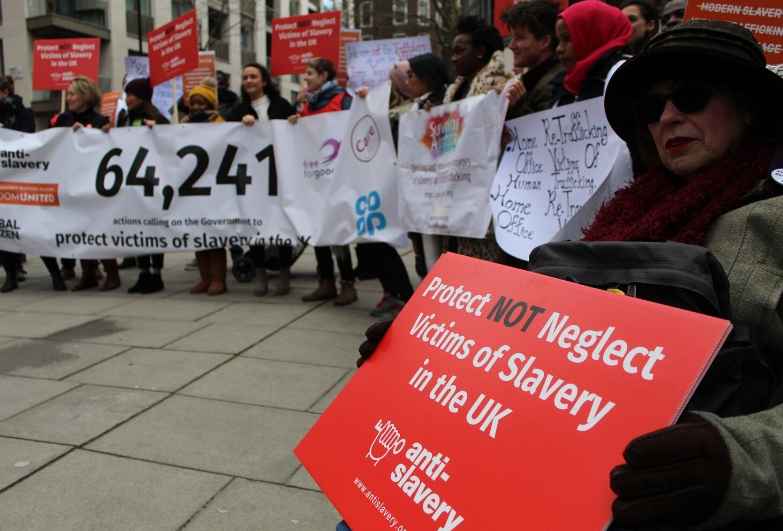
We campaign for the UK Government to make sure that it recognises the rights and needs of people who have been exploited. We work to improve the policies and practices already in place to make sure there are adequate support and prevention systems in place. We also push the UK Government to listen to experts and be wise to the fact that restrictive immigration policies – such as severe caps on entry, and “tied” work visas – can push people dangerously into the hands of traffickers and exploitative work practices.
Over the past years, we’ve led various campaigns:
- We campaign to ensure no one is punished for the crimes they were forced to commit as part of their exploitation and have been instrumental in a recent legal challenge against survivors being disqualified from identification and support.
- We continue to campaign for Dignity Not Detention for survivors of modern slavery in the UK.
- Since 2021 we’ve campaigned to amend the Nationality and Borders Act, which is preventing many survivors from accessing identification and support as found by research we have contributed to.
- In 2023, we led a campaign against the “Illegal Migration” Bill – now Act. This cruel law unpicks crucial support to survivors of modern slavery and provides further barriers to access that will prevent many people from accessing support. Many of its provisions have now been removed by the Border Security, Asylum and Immigration Act 2025, but some damaging provisions around disqualifications have been retained, but are not yet in force.
Modern slavery and business
Around the world, people are forced by governments or businesses into working in conditions they didn’t agree to, and they are then unable to leave. There are 17.3 million people in forced labour exploitation in the private sector, and an estimated almost 4 million in state-imposed forced labour, and we urgently need new laws in the UK and globally to prevent this grievous harm and end corporate profiteering from forced labour.
In the UK, we are campaigning for a toolbox of measures to tackle forced labour in business supply chains that go beyond the current Modern Slavery Act. We urgently need both a Business, Human Rights and Environment Act – that would require businesses to clean up their supply chains – and import controls – to prevent goods tainted with forced labour from entering the UK market. We also work with businesses as a “critical friend” to help them identify and address risks of modern slavery in their supply chains. Find out more about our business advisory services.
Our partnerships have involved working with businesses including ASOS and TFG London, to review and improve on-the-ground sourcing practices, identify risk areas and strengthen processes to prevent exploitation.