Slavery resources

Speak out about modern slavery
We have a host of resources available for individuals, schools and faith groups
Download our free resources to help raise awareness of modern slavery in your communities
Principal elements of a UK corporate duty to prevent adverse human rights and environmental impacts – A ‘failure to prevent’ law
Climate-induced migration and modern slavery
Anti-Slavery International partnered with the International Institute for Environment and Development (IIED) to publish a report exposing the relationship between climate change, forced migration and modern slavery. The report finds that climate change heightens existing vulnerabilities of slavery and that there are three emerging pathways linking climate change, migration and modern slavery: sudden events in the aftermath of disasters, slow onset events/disasters, and slow onset events combined with conflict and forced displacement.
EU law. Global impact. A report considering the potential impact of human rights due diligence laws on labour exploitation and forced labour
The European Commission will soon publish a proposal for an EU business and human rights law that would require companies operating in the EU to prevent and address human rights abuses and environmental damage in their global supply chains. This commitment to mandatory human rights and environmental due diligence could help tackle forced labour and child labour in supply chains around the world.
On 28 June 2021, we published new research, undertaken by the Rights Lab, University of Nottingham, to understand how the upcoming EU business and human rights law could affect workers’ human rights through two case studies: the leather industry in India, and the coffee industry in Brazil.
Anti-Slavery International and European Center for Constitutional and Human Rights’ position on import controls to address forced labour in supply chains
Following the G7 Summit in Carbis Bay, we, together with the European Centre for Constitutional and Human Rights, have published a position paper on when and how governments should introduce import controls to end forced labour. Import controls should not be the only measure used to address forced labour in global supply chains. Instead, they should be introduced as part of strong legal, trade and development framework to address the root causes of forced labour – poverty, lack of legal protection, worker representation and discrimination. In particular, we have worked for many years to call for the introduction of stronger laws such as mandatory human rights and environmental due diligence (mHREDD), and we believe that the two approaches – mHREDD and import controls – are complementary. Although specifically concerned with developments in the EU, this position paper is applicable to all governments.

Agents for change: survivor peer researchers bridge the evidence and inclusion gap (2020)
Agents for Change is a briefing that shares reflections on the lessons and challenges of a small research team originally formed to conduct research on long-term outcomes for survivors of slavery in the UK in 2020. The team consisted of three women with lived experience of modern slavery and the Anti-Trafficking Monitoring Group (ATMG). Co-written by survivors and non-survivors of slavery or exploitation, this briefing shares collective and individual reflections on the process of working and learning together to date.
From a vicious to a virtuous circle: Addressing climate change, environmental destruction and contemporary slavery
Climate change is a global crisis with serious implications for all of humanity. For people who are vulnerable to exploitation, it can be especially serious: climate change can drive a vicious circle that traps people into working in industries that contribute to environmental harms, which can in turn intensify the conditions that leave people vulnerable. In our research report, author Dr Chris O’Connell, CAROLINE Fellow at Dublin City University, examines the causes and effects of climate-linked modern slavery, and identifies practical recommendations for policy makers to tackle the problem.
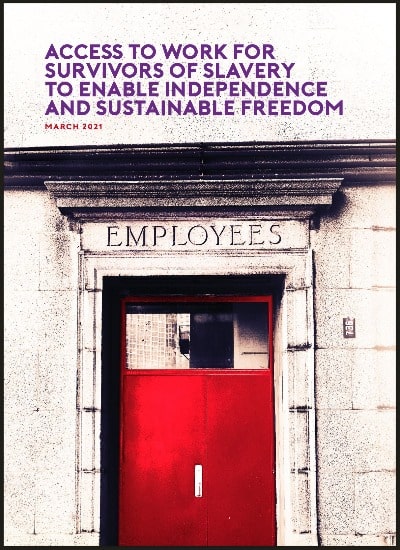
Access to work for survivors of slavery to enable independence and sustainable freedom
In order for survivors of modern slavery to recover from their exploitation, it’s essential the UK provides meaningful options to help them. This includes providing options to build independence and sustainable freedom through work, as well as through education, counselling and access to legal justice. This is a simple, achievable ask, which would do much to help survivors to move on from exploitation and to rebuild their lives. This report, produced by a coalition of organisations including Anti-Slavery International, examines the harm caused by denying survivors the right to work, as well as offering recommendations to make sure the National Referral Mechanism is reformed to allow people within the system to access work.
Joint briefing: Subsistence payments and legal aid eligibility for victims of trafficking: accessing one entitlement to lose another
People who are in the National Referral Mechanism for identifying victims of trafficking (NRM) are ‘entitled’ to legal aid. However legal aid is also means tested. This means not everyone in the NRM is able to access legal aid in practice. This poses a significant barrier to justice for people who are not eligible and denies them a key entitlement. We recommend that being in the NRM should also passport you through the legal aid income and capital tests. This would mean that everyone in the NRM would be able to access legal aid.
Anti-Slavery International’s submission to the European Commission consultation for an initiative on sustainable corporate governance (mHREDD)
Anti-Slavery International response to the public consultation on the need and objectives for EU intervention on sustainable corporate governance. We took part in this consultation, together with partner organisations in more than 20 countries, including Bangladesh, Brazil, Chile, Colombia, Ghana, India, Indonesia, Nepal, South Africa and Turkmenistan. We also actively encouraged our supporters and allies to do the same, and we want to thank everyone who took part: this consultation proved to the European Commission that people all over the world look to the EU to show leadership, courage and compassion for oppressed people everywhere.
National Referral Mechanism multi-agency assurance panels: a review
This briefing reviews the provisions of the recently established Multi-Agency Assurance Panels (MAAPs) to date, assessing the extent to which they contribute to robust and transparent decision-making in the NRM. It focuses on the practical function of the MAAPs based on a survey conducted by ATMG in 2019, and feedback from 8 panellists. It goes on to highlight how this new approach to decision-making has revealed poor information sharing practices between relevant bodies, therefore undermining panel members’ ability to quality assure second stage negative decisions. In addition, it asks questions about victim support provisions more widely, especially for those engaging with the criminal justice system.