Slavery resources

Speak out about modern slavery
We have a host of resources available for individuals, schools and faith groups
Download our free resources to help raise awareness of modern slavery in your communities
Joint submission to the Group of Experts on Action against Trafficking in Human Beings

Leaving no-one behind: Insights and recommendations for donors, business and policymakers
Anti-Slavery International.
Covid-19 has the potential to negatively affect everyone, but it does not affect everyone equally. This report includes insights and recommendations for policymakers, donors and business leaders to ensure that responses to Covid-19 reach victims of modern slavery and people vulnerable to slavery, along with short and long term measures to build resilience and prevent an increase to modern slavery.
COVID-19 and modern slavery victim support: joint letter to the Minister of Safeguarding
Joint letter from organisations within the anti-slavery sector to the UK Minister of Safeguarding asking for a clear plan and resourcing for survivor support in the context of COVID-19.
Protecting Child Domestic Workers in Tanzania: Evaluating the scalability and impact of the drafting and adopting of local district bylaws
Rights Lab, University of Nottingham, Anti-Slavery International.
Facing high population growth and extreme poverty, domestic work in Tanzania offers the opportunity for children with little education to enter paid employment. This report describes an evaluation and analysis of the impact of the drafting, and prospective adoption, of local bylaws designed to protect the rights of such Child Domestic Workers (CDWs) in the districts of Ilemela and Nyamagana in the Mwanza region of Tanzania.
UN Human Rights Committee submission: modern slavery in the UK (2021)
The following report to the UN Human Rights Committee by Anti-Slavery International and nine other UK civil society organisations, assesses the UK Government’s response to trafficking and modern slavery, including the situation of trafficked children and migrant domestic workers.
While welcoming a number of significant and positive improvements to the law and policy framework addressing trafficking and modern slavery in the past few years, the report highlights critical gaps in the UK’s response. Obstacles persist in ensuring that victims are identified and protected, preventing survivors from being able to access the support needed to rebuild their lives away from slavery. The current Overseas Domestic Worker visa in place makes migrant domestic workers more vulnerable to abuse. Safeguards promised by the Government are not being implemented, and a fresh approach is needed to prevent their exploitation, including a return to, at minimum, the rights in place for migrant domestic workers prior to 2012. There are also significant gaps in the provision of care and support for child victims of trafficking, and the current identification system is not fit for purpose for child victims. Together, we call for a number of reforms to ensure that children and adults who have been trafficked or in modern slavery in the UK can be effectively identified, protected and supported, as well as having access to justice and remedy.
A call to action from over 100 NGOs for EU human rights and environmental due diligence legislation
Over 100 civil society organisations and trade unions have called on the European Union to bring forth this term new corporate accountability legislation requiring companies to respect human rights and the environment in their global value chains and operations. Such legislation should establish a corporate duty to respect human rights and the environment and require companies and financial institutions to identify, prevent, mitigate and account for abuses and harm in their domestic and global operations, activities, products, services, supply chains and exports. The legislation should hold such companies legally accountable and provide access to justice for victims.
Anti-Slavery has been leading this action, together with NGO partners including Clean Clothes Campaign and the European Coalition for Corporate Justice.
A call for EU human rights and environmental due diligence legislation:
Legal guide: identification, rescue, rehabilitation and prosecution of bonded labour in the brick kiln industry
This guide is intended to equip activists with legal knowledge to eradicate the bonded labour system in India’s brick kiln industry. The brick kiln industry employs more than 10 million workers and is one of the bonded labour prone industries in India. Workers pawn their health, safety, social security, their children’s health and education in exchange for a bare sustenance. This guide provides tools for the identification, rescue, rehabilitation and prosecution of cases of bonded labour, focusing mainly on the implementation of the Bonded Labour Act and other applicable laws and procedures. It also suggests strategies that may be useful when dealing with the tough challenges faced in the process.
Human Rights Council submission – forced child begging in Senegal
Joint submission by Anti-Slavery International and La Rencontre Africaine pour la Défense des Droits de l’Homme (RADDHO) to the 127th session of the Human Rights Committee 14 October – 8 November 2019. This submission contributed to the 5th periodical review of Senegal. The submission urges the Government of Senegal to demonstrate sustained and consistent political will to end forced begging of talibés and take additional measures to enforce laws, prosecute perpetrators, protect children forced to beg, and accelerate the implementation of daara modernisation to eradicate mistreatment and exploitation of over 100,000 Talibe.
Submission to the UK government on the UK Transparency in Supply Chains Clause of the Modern Slavery Act
Submission by CORE Coalition, Anti-Slavery International, Amnesty International, Business and Human Rights Resource Centre, Christian Aid, Environmental Justice Foundation, Fairtrade Foundation, FLEX, Freedom Fund, Freedom United, Traidcraft Exchange, TUC, UNICEF and UNISON.
We’re calling on the UK government to:
- Introduce mandatory criteria for reporting
- Introduce an effective Government-run registry
- Introduce meaningful sanctions for failures to comply with the TISC provision
- Extend the reporting requirement to the public sector
- For the UK government to go beyond reporting and introduce mandatory human rights due diligence.
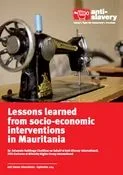
Lessons learned from socio-economic interventions in Mauritania
Anti-Slavery International, SOS-Esclaves, Minority Rights Group International and Salamata Ouédrago Cheikhou.
This study assesses the impact of three income-generating activities (IGA) projects implemented in Mauritania between 2017 and 2019 by partners Anti-Slavery International, SOS-Esclaves and Minority Rights Group International (MRG). Convinced of the need to incorporate a socio-economic approach as part of the assistance given to survivors of slavery, Anti-Slavery and partners have endorsed investment in socio-economic initiatives to support the most vulnerable victims of slavery.