Image credit: imageBROKER on Shutterstock
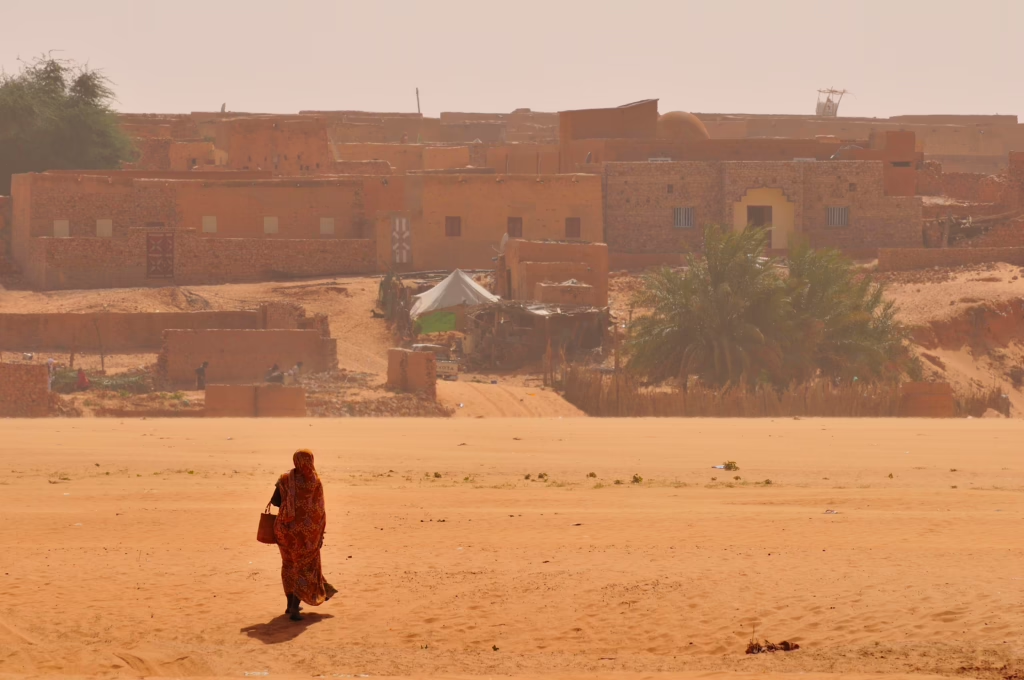
Disclaimer: The woman pictured in the stock image does not represent the people being described in the blog.
It is estimated that, as of September 2025, between 90,000 and 149,000 people remain trapped in slavery in Mauritania. Most are from the Haratine community, a historically marginalised people found across the West African Sahel, including Mauritania, Morocco, Western Sahara, Senegal, Niger, and Algeria.
For generations, Haratine people in Mauritania have faced systemic discrimination alongside the legacy of descent-based slavery. Many continue to experience barriers to education, political participation, economic opportunity and access to justice, while those who challenge these injustices often face intimidation and repression.
Descent-based slavery is a form of slavery where people are born into exploitation because their ancestors were enslaved. Their status is inherited across generations, often tied to caste-like systems, ethnicity, or social hierarchy. People in descent-based slavery are frequently denied basic rights, face severe discrimination and stigmatisation, and are treated as property by those who claim ownership over them.
Mauritania’s social structure has long been shaped by a descent-based caste system. At the top are the Beydane (also known as Bidan), an Arab-Amazigh community that has historically held political and economic power. Below them are several other social groups, including Afro-Mauritanian communities and the Haratine. For centuries, many Haratine families were subjected to descent-based slavery under this system, with enslaved status passed on from one generation to the next.
Although Mauritania became independent from France in 1960, this deeply rooted system of inequality continued. The country’s first constitution promised equality for all citizens, yet many Haratine people remained in slavery. Slavery was only formally abolished in 1981 and was not made a criminal offence until 2007.
Despite these legal reforms, implementation has remained weak. The Mauritanian authorities have repeatedly downplayed or denied the continuing existence of slavery, meaning many perpetrators have never been held accountable. Although specialist anti-slavery courts were established in 2015, survivors continue to face major barriers to accessing justice. Meanwhile, anti-slavery organisations and activists in Mauritania, including SOS-Esclaves and the Initiative for the Resurgence of the Abolitionist Movement (IRA), have faced harassment, arrest, and imprisonment for their work.
Barriers to freedom
For Haratine people who have escaped slavery, discrimination continues to shape everyday life. The community is disproportionately affected by poverty and exclusion, with limited access to education, secure employment, political representation and public services. Many also struggle to obtain birth certificates and other official identity documents, leaving them effectively excluded from full citizenship and the rights that accompany it.
People born into slavery often were never registered at birth because they lived under the control of their enslavers and had little or no contact with state authorities. Without legal identity, survivors of slavery and people of slave descent can be prevented from accessing education, healthcare, formal employment, land rights, legal protection and the right to vote. This makes it far more difficult for survivors to recover and rebuild their lives. Without access to land, work or state support, some survivors are forced back into exploitative relationships with their former enslavers simply to secure food and shelter. Others settle in informal urban communities or rural villages known as Adwabas, where opportunities remain scarce and poverty is widespread.
Documenting Haratine experiences
The Haratine Imprints Documenting Erasure (H.I.D.E.) project is a digital archive documenting the contemporary experiences of Haratine people in Mauritania. Founded by students at the University of California, Los Angeles (UCLA) and now sponsored by the Mauritanian Network for Human Rights in the U.S. (MNHRUS), the project preserves testimonies that might otherwise be lost while building evidence to support human rights advocacy, accountability efforts and legal action. Its long-term goal is for this evidence to support human rights advocacy, accountability efforts and legal action where appropriate.
Working with the Mauritanian Network for Human Rights in the U.S. and the Mauritanian anti-slavery organisation SOS-Esclaves, the project conducts online interviews with Haratine participants. Alongside oral testimonies, it brings together written and visual evidence to build a secure archive that can support future human rights advocacy and legal action.
To protect participants, the archive itself is not publicly accessible. However, the testimonies reveal recurring patterns of discrimination, exclusion and abuse that continue to shape the lives of many Haratine people today.
Testimonies from the archive
Some participants describe being born into descent-based slavery and the lasting psychological impact of a system that teaches people they are born to serve others.
“Most of the enslaved people grew up with the belief that they owe everything to their masters, and if they do not abide, they would go to hell.“
Others recall being subjected to exhausting forced labour from childhood and witnessing severe violence against people who attempted to resist or escape.
Even participants who were never enslaved describe widespread discrimination affecting almost every aspect of daily life. Testimonies speak of segregated communities, exploitative sharecropping arrangements, and the loss of livelihoods through racial and economic discrimination.
“His village has been divided between an area where light-skinned Bidan lived and where the Black-skinned and Haratine people lived.“
Many participants also describe being denied rights that others take for granted, including access to education, healthcare, housing and legal recognition.
“I wish I had a normal life and lived in a country where my basic human rights were respected.”
Others explain that many Haratine families struggle to obtain civil documentation, making it harder to access public services, education and employment. Some describe being repeatedly displaced after settling on vacant land because they have no recognised property rights.
Taken together, these testimonies show that the legacy of slavery extends far beyond the institution itself. They document the ongoing discrimination, exclusion and inequality that many Haratine people continue to experience today.
Learn more about H.I.D.E.
To protect participants, the full archive is not publicly accessible. However, H.I.D.E.’s public website shares more information about the project and the human rights issues facing Haratine communities in Mauritania.
If you are interested in using the archive to support human rights advocacy or legal action, or would like to donate in support of H.I.D.E.’s work, you can contact the team at [email protected].