Slavery resources

Speak out about modern slavery
We have a host of resources available for individuals, schools and faith groups
Download our free resources to help raise awareness of modern slavery in your communities
Rights and Recourse: A Guide to Legal Remedies for Trafficked Persons in the UK
Begging For Change: Research findings and recommendations on forced child begging in Albania/Greece, India and Senegal
Anti-Slavery International, Emily Delap.
This report is based on research conducted in Albania and Greece, India and Senegal, and looks at the phenomenon of forced child begging both in its local specifics and global commonalities. Forced child begging involves forcing boys and girls to beg through physical or psychological coercion. ISBN 978-0-900918-73-5
Begging For Change: Forced Child Begging: A toolkit for researchers
Anti-Slavery International, Emily Delap.
A toolkit outlining qualitative methods for researchers interested in exploring the more exploitative and damaging forms of child begging, where children have been physically forced or coerced into their work. However, manyof the tools and methods can be adapted to find out about the lives of other girls and boys living or working on the streets, and about other hard-to-reach and exploited groups of children. ISBN 978-0-900918-72-8
Begging For Change: Forced Child Begging: Tools for an introductory training course on qualitative research methods
Anti-Slavery International, Emily Delap.
Tools developed for training research teams who took part in a pilot research project on forced child begging. Aims to provide the reader with the basic skills needed to carry out qualitative research, with a particular emphasis on research with children. ISBN 978-0-900918-74-2
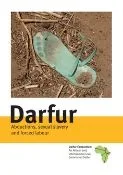
Darfur Abductions: sexual slavery and forced labour
Darfur Consortium: An African and International Civil Society for Darfur.
Research by the Darfur Consortium has found that Government supported militia, like the Janjaweed and the Popular Defence Forces, together with the Sudanese Armed Forces, have systematically abducted civilians for the purposes of sexual slavery and forced labour as part of the Darfur conflict. The report investigates the pattern of abductions, the issues behind them, including ethnicity and lack of protection, and concludes with some recommendations to address the abductions.
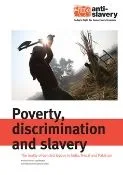
Poverty, Discrimination and Slavery: The reality of bonded labour in India, Nepal and Pakistan
Anti-Slavery International, Krishna Prasad Upadhyaya.
This report is a study of the reasons why bonded labour, a contemporary form of slavery, persists in India, Nepal and Pakistan. In particular, it examines the effectiveness of state interventions against bonded labour. This report reflects the main findings of research carried out by CEC, GEFONT and PILER between 2004 and 2006 into some of the obstacles to the eradication of bonded labour, the reasons why bonded labour persists, and into the interventions that have been made since anti-bonded legislation came into force in South Asia. It includes a number of recommendations which if fully implemented would lead to the eradication of bonded labour in South Asia. ISBN: 978-0-900918-70-4.
Opportunities and Obstacles: Ensuring access to compensation for trafficked persons in the UK
Anti-Slavery International
Although there has been an increase in the number of convictions for humantrafficking in the UK, legal remedies and compensation for traffickedpersons have remained inaccessible. This report identifies the legalremedies available to trafficked persons in England andWales andanalyses the effectiveness of each remedy viewed in light of itsaccessibility to trafficked persons.
Janice Lam & Klára Skrivánková
Arrested Development: Discrimination and slavery in the 21st Century
Anti-Slavery International, Mike Kaye.
Discrimination is a pivotal part of slavery because it allows people to disengage their humanity and justify or tolerate the violation of other people’s human rights. Discrimination also limits certain groups’ access to education, jobs and healthcare, leaving them to subsist at the margins of society where they are extremely vulnerable to enslavement as they look for ways to provide for themselves and their families. This publication highlights what action needs to be taken by governments and other international agencies to ensure that every human being – without exception – should be able to live a life free from slavery. ISBN:978 0 900918 66 7
‘They Respect Their Animals More’: Voices of child domestic workers
Anti-Slavery International, Jonathan Blagbrough.
This report is the product of group discussions and individual interviews with more than 400 current and former child domestic workers from urban and rural areas in Benin, Costa Rica, India, Nepal, Peru, Philippines, Tanzania and Togo, to inform about the situation and needs of child domestic workers in order to better target programmes and policies on the issue. It also aims to encourage thinking about child domestic workers not simply as subjects of concern, but as social actors able to articulate their needs and capable of transforming their own lives, and the lives of others.ISBN:978 0 900918 65 9
Forced Labour in North Korean Prison Camps
Anti-Slavery International, Norma Kang Muico.
This report focuses on returned North Korean migrants who are subjected to forced labour in North Korean prison camps following their deportation from China. The findings of the report are based on interviews carried out with North Koreans who were subjected to forced labour while in detention. The report includes photographs and 30 cases. Most of those interviewed were subjected to forced labour before being prosecuted, which violates international standards as well as North Korea’s domestic law. The report also outlines what measures need to be taken to address this situation (also available in Korean, see translations page)