Slavery resources

Speak out about modern slavery
We have a host of resources available for individuals, schools and faith groups
Download our free resources to help raise awareness of modern slavery in your communities
Found 47 resources matching your current query.
SDG Summit Gap on Forced Labour, Trafficking and Child Labour
- Reaffirm their commitment, in the strongest terms possible, to the full, effective, and meaningful implementation of SDG 8.7.
- Recognising that SDG 8.7 is deeply interconnected with achieving most of the SDGs, significantly increase your Government’s efforts to address the root causes of forced labour, modern slavery, human trafficking, and the worst forms of child labour, inter alia, poverty, discrimination, gender inequality, climate change, and conflict.
- Ensure that all efforts and deliberative and decision-making processes are survivor-led, centred, and informed, and commit to adopting multi-stakeholder and intergenerational partnerships to support prevention, protection, and prosecution efforts.
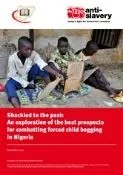
Shackled to the past: An exploration of the best prospects for combatting forced child begging in Nigeria
Anti-Slavery International, Research Centre for Human Rights and Civic Education (CHRICED)
Nigeria has more children growing up without a formal education than any other country. Largely unregulated and poorly positioned to serve as a safety net for underfunded and overstretched public education services, the Almajiri system has, since the 1980s, moved away from its roots as a traditional form of structured religious guidance to one based on exploitation, in which students are expected to sustain the schools and their own subsistence through begging and child labour. Limited effort made to improve the conditions at Qur’anic schools and this report outlines why previous interventions have failed, and what must happen to achieve progress in the future.
Joint submission for the Universal Periodic Review of Niger, 38th session
A joint submission by Anti-Slavery International, ANTD (Association Nigérienne pour le traitement de la délinquance et la prévention du crime), and Timidria, for the Universal Periodic Review of Niger, 38th session. It provides information and recommendations on descent-based slavery; the impact of Covid-19 on slavery; discrimination against people of slave descent; access to education for children of slave descent; the worst forms of child labour in Niger including forced child begging of talibés (children who study at residential Quranic schools), children in descent-based slavery, and of child domestic workers; and the wahaya (so-called 5th wife) practice.
Submission on forced child begging and descent based slavery Oct 2020:

Reaching out for justice: Overcoming barriers for child survivors of sexual exploitation and trafficking accessing justice in Nepal
Anti-Slavery International, Children-Women in Social Service and Human Rights (CWISH) and Samrakshak Samuha Nepal (SASANE)
Nepal has long experienced high levels of child sexual exploitation and child trafficking for sexual purposes. Poverty, lack of education, peer pressure and the necessity of finding employment, have all compounded structural barriers and social prejudices built into patriarchal systems to increase the vulnerability of children, particularly girls, to sexual exploitation. This report outlines the findings of a qualitative study on the access to justice experiences of survivors of child sexual exploitation and trafficking in Nepal.

Suffering under silence: investigation into the forced begging of Talibé children in Niger
Anti-Slavery International, Rencontre Africaine pour la Défense des Droits de l’Homme (RADDHO), Association Nigérienne pour le traitement de la délinquance et la prévention du crime (ANTD)
In partnership with Anti-Slavery International (United Kingdom), RADDHO – Rencontre Africaine pour la Défense des Droits de l’Homme (Senegal), ANTD – Association Nigérienne pour le traitement de la délinquance et la prévention du crime (Niger), has conducted a study to address the lack of information on the widespread, yet under-documented phenomenon of forced begging of talibé children (hereafter ‘talibé’) in Niger. The research report presents the state of forced-child begging among talibé in Niger; depicts the profiles and living conditions of these children; and analyses the domestic legal environment relating to child protection.

Leaving no-one behind: Insights and recommendations for donors, business and policymakers
Anti-Slavery International.
Covid-19 has the potential to negatively affect everyone, but it does not affect everyone equally. This report includes insights and recommendations for policymakers, donors and business leaders to ensure that responses to Covid-19 reach victims of modern slavery and people vulnerable to slavery, along with short and long term measures to build resilience and prevent an increase to modern slavery.
Human Rights Council submission – forced child begging in Senegal
Joint submission by Anti-Slavery International and La Rencontre Africaine pour la Défense des Droits de l’Homme (RADDHO) to the 127th session of the Human Rights Committee 14 October – 8 November 2019. This submission contributed to the 5th periodical review of Senegal. The submission urges the Government of Senegal to demonstrate sustained and consistent political will to end forced begging of talibés and take additional measures to enforce laws, prosecute perpetrators, protect children forced to beg, and accelerate the implementation of daara modernisation to eradicate mistreatment and exploitation of over 100,000 Talibe.

Difficult path to freedom: 10 years of working to eradicate slavery in West Africa
Anti-Slavery International.
Multiple human rights violations are suffered by people born into slavery. This report identifies the lessons learned over 10 years of programmes to combat descent-based slavery in West Africa. It analyses the programmes to support people who escaped slavery to build their lives in freedom and advocate for their rights. It also draws attention to the systemic problems facing the victims and the challenges to encourage the governments to implement comprehensive anti-slavery and anti-discrimination policies, that would bring freedom to all people affected by descent-based slavery.
Forced child begging in Senegal
This briefing assesses Senegal’s compliance with ILO Convention No. 182 on the Worst Forms of Child Labour (ratified in 2000), with regard to the issue of forced child begging of talibés.
Forced child begging in Senegal (March 2019)
Anti-Slavery International briefing on child begging in Senegal. Submission to the 125th session of the UN Human Rights Committee, 4 to 29 March 2019.